Tuesday, April 28, 2015

MBFE - Day 7 - Sun and Sand

Man oh man, Monday April 27th was a beautiful day on the southern Oregon coast.  You rarely see nicer!  The skies were clear and blue, highs were in the upper 70s, and there was only a gentle breeze.

Earlier in the morning I was debating whether the class should do dock, pier and piling communities or sandy beaches, but when I walked back to my place after breakfast the weather clinched it.  It HAD to be sandy beaches.  Sun and sand just go together.

The plan for the day was to visit several nearby beaches, find and identify as many sand beach community species as we could and collect samples of sand from beaches that ranged from highly protected from wave action to beaches that are fully exposed to pounding waves.  The crew will then later use a set of progressively smaller sieves to sort the sand into size classes and characterize each beach based on sand particle size.


The first stop of the afternoon was Bastendorf Beach, just south of Charleston, OR.


Here is most of the crew (L-R: Rachel S, Jessica, Danielle - behind Jessica, Kelly, Rachel M., Shannon, Jennifer, Courtney, Arianne, Joseph, Devon, and Luke) at our first stop of the day - Bastendorf Beach.  It's a wide beach with moderate wave exposure.  We did some digging, some looking, and found pretty much...a worm.

Our next stop was just around the next point, Lighthouse Beach, Point Gregory:


We found some awesome things there.  


A few students found a couple of dungeness crabs - here's Isaac showing off the find, and yes he knows hes' holding it upside down, but he didn't want to let go of the pincers.  He's so wise.


You can tell that this experience is already seriously affecting the class...I take them to a beautiful beach and they head immediately for the rocky point to see what's on the rocks (L-R: Shannon, Luke, Joseph, Devon, Jennifer).  While there we saw something that's incredibly bizarre, squid egg masses all over the rocks and filling the tide pools.


This is just a couple of small clumps compared to all the egg masses we saw.  We brought some back to the lab for observation. 

Our next stop was Sunset Bay.  This is a beautiful bay that is almost completely surrounded by cliffs and is highly protected from wave action.  It fills during high tides and nearly empties during low tides.


Devon and Luke made an usual sighting there.  They spotted something swimming out of the mouth of a small stream that empties into this bay...it as a 12-16" lamprey.  Devon nearly caught it, but it was just too slippery!  It's the first live lamprey any of us had ever seen.  It was awesome!  Well, as awesome as lamprey can be.  Here's what they look like:


Our next beach stop was Simpson Beach.  


Like Sunset Bay, Simpson Bay has a narrow opening to the sea, but unlike Sunset Bay, Simpson Beach takes a serious pounding when the tide and waves are high.  This is evidenced by the beach safety sign you see as you reach the beach.  Don't worry, we were safe.


The find of the day at Simpson Beach was a cave that went back maybe 30-40 feet.  Here are Luke, Isaac (background) and Devon in the cave.


Our last stop was Cape Arago, where sand samples were collected from South Cove and Middle Cove.  The South Cove collection came off without a hitch...we've already been there a few times as a class.  The Middle Cove sample, however, included a notable misadventure.  

This is Middle Cove, Cape Arago:


I readily admit that I've never been down to Middle Cove, but colleagues told me that there is a steep, but accessible though rough trail...so I found what looked like could be a trail and Joseph, Luke, and Devon were willing to give it a try.  They started down and I then went over to organize a team to collect sand from South Cove. When I got back to the top of Middle Cove to see how that group was doing, they were still very close to the starting point.  Luke had however slipped/slid down a steep slope.  The other two were still close to the starting point.  I told them to hang on and I did a little more exploring and found the real trail head.  Joseph and Devon were able to make it back up, but not Luke...poor guy!  

This photo shows Joseph working his way down toward Devon.  If you look carefully you can see Luke in white over by the large fallen tree.  He had to bushwhack his way over to the other guys and the actual trail.  


Fortunately everything worked out in the end, and here they are collecting the sand sample they were sent to retrieve.  


OK, field trip tally:  6 beaches, sand, sun, a few sunburns, crabs, squid eggs, a lamprey, a cave, and one significant misadventure that turned out alright in the end...thanks to Luke's good nature.

Stay tuned to see what happens next!

Sunday, April 26, 2015

MBFE - Numb Tongue

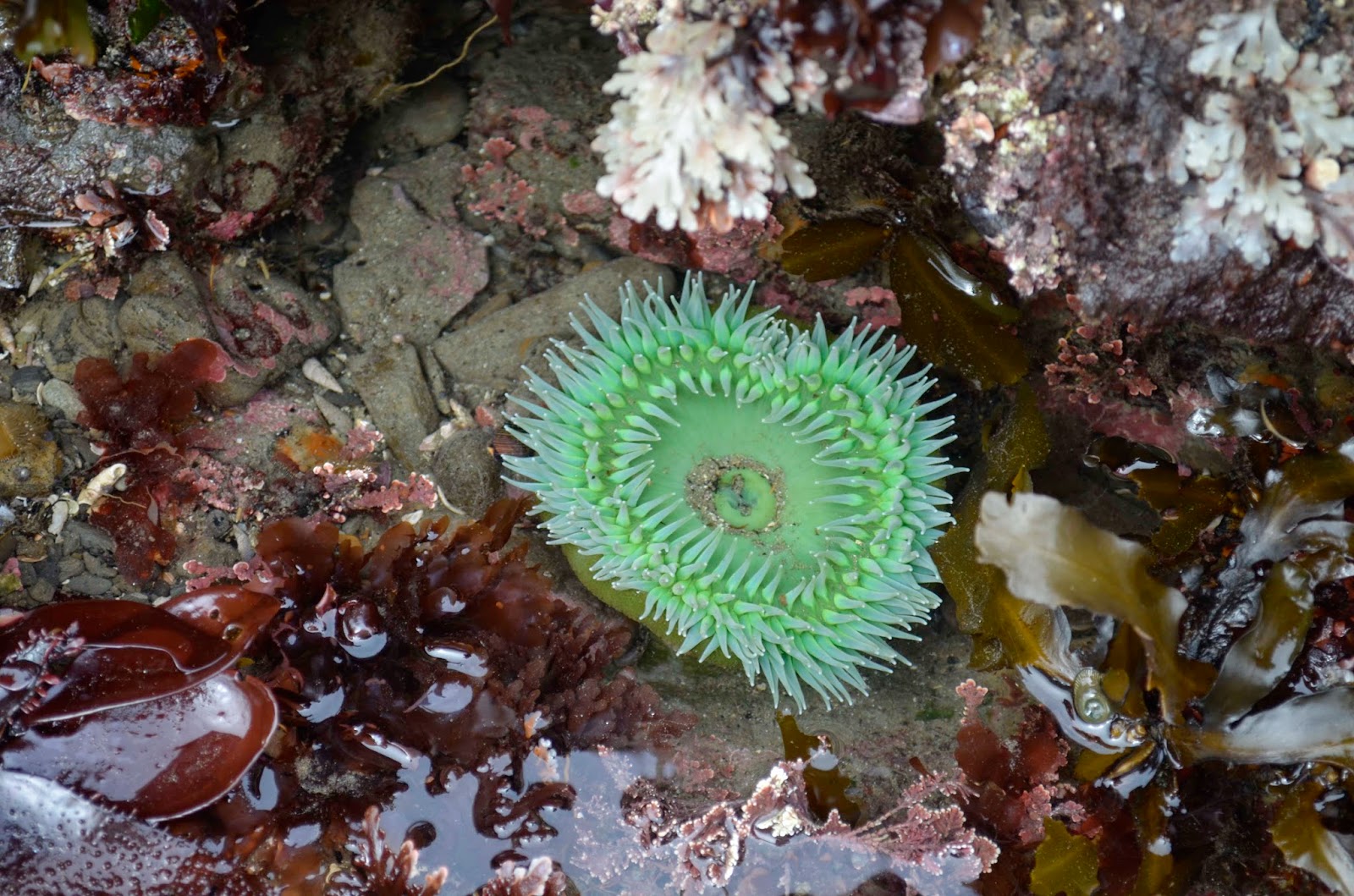
During class lectures we talk about different communities of marine organisms.  One group of animals that lives on rocky shores are sea anemones, including the aggregating anemone Anthopleura elegantissima and giant green anemone Anthopleura xanthogrammica.

Anthopleura xanthogrammica in a tide pool.

Sea anemones are beautiful animals related to jellyfish and coral.  They make their living by using stinging cells to capture plankton and other things that get too close.  You can, by the way, find just about anything sticking out of the mouth of a sea anemone.

Anyway, a few days ago while talking about these fascinating animals a question came up that almost always does, "Can these animals hurt us?"  Well, some tropical species pack a pretty good wallop, but the species along the west coats don't affect us, unless someone decided to lick one.  If they did that, they'd probably just get a numb-tongue.

So earlier this week I came strolling into the lab to see how things were going and Isaac starts grinning at me so I ask what's up.  He licked a sea anemone to see what would happen and sure enough, he got numb-tongue.  Actually he said it was more tingly than numb...and it took two to three hours for the effects to wear off.

Way to go Isaac!  That's a life experience few people (including me) haven't had.

Lick an anemone, get a numb tongue!

Saturday, April 25, 2015

MBFE - Day 4 - MUD!!!

Remember when your mom told you not to splash in that puddle or to stay out of the mud and keep your clothes clean?  Today was the day that all went out the window.  Why?  The topic for the day was mud flat communities.  We spent the previous few days working in the rocky intertidal zone, but there's more to near shore marine communities than just rocky shores.

The crew spent the morning digging in and studying life in mud.

Our destination was the mud flat adjacent to the Charleston Harbor just upstream of the South Slough Bridge in Charleston, OR.  That's a convenient place to go since we just pulled on our boots, grabbed buckets, shovels and other gear, and took a nice half mile stroll to the mud flats.

The plan was to plot the vertical profile of the mud flat area from water's edge to the top of the flat. The class was divided into four teams who spent time digging in the mud every 5 meters along the 150 meter transect, observing what they saw, collecting specimens from their sites, and then sharing data with each other that evening.

Here are a few action shots from the day.


Here are several of the crew (L-R Courtney, Danielle, Jessica, Kelly (fore), Eileen (back), Skyler, Isaac, Jennifer, Rachel S, and Shannon).


Here are (L-R) Jennifer, Shannon, and Rachel getting into it.


Here are (L-R) Eileen, Skyler, and Isaac.  They loved to dig!    


Jessica and Danielle were not to be outdone.

They LOVED it!  Even though it was breezy and a bit rainy.  The crew found all kinds of clams, worms, and mud shrimp.  

We wrapped up the work day by attending the Oregon Institute of Marine Biology weekly seminar. The presenter this week was Dr. Yizhen Li of the Woods Hole Oceanographic Institute, Massachusetts.  He presented work he has done to help improve our predictions of harmful algal blooms (i.e., red tides) in the Gulf of Maine.  It was pretty impressive stuff.

It was Friday night, so it after dinner it was time to relax at least a bit.  Several members of the group decided to join Dr. Holyoak for a movie, "Guardians of the Galaxy."  It's a very silly but fun show. Some of the University of Oregon students who are studying here at OIMB were a bit envious that we had a professor-student movie night.


Stay tuned for more updates of activities and adventures of the Marine Biology Field Experience at OIMB.

Thursday, April 23, 2015

MBFE - Day 3 - Back to South Cove to study tide pools

Today dawned gray and drippy, but that didn't stop us.  We had another great low tide, so out we went.  This group is fantastic...no worries, no complaints, and good solid workers!

We arrived at South Cove, Cape Arago around 9:30 am and made our way down to the beach.


Here's the crew making their way over the drift logs at the bottom of the trail and then over to the rocky intertidal zone.  

Today's field work included collecting data to generate species diversity index values for low, middle, and high intertidal zone tide pools.  This way students could see how tide pools make it possible for organisms to live much higher in the intertidal zone than they can out of tide pools.


Here's one of the teams at work (L-R Skyler, Devon [facing away], Rachel S, Shannon, and Eileen). Note the smiles!  

Tide pools are extremely interesting places since no two pools are alike in size, shape, depth, or community composition.  Here are a few examples:


Here's a tide pool in the low intertidal zone - notice how it's full of surf grass and algae.


Here's a tide pool in the mid-intertidal zone.  It's dominated by red coralline algae and sea anemones.


Here are a few tide pools in the upper intertidal zone.  Notice that the rocks around the pools have only scattered small barnacles and that there is lots of bare rock. The pools, however, are lined by mussels and contain some large sea anemones.

Lastly, here's a tiny tide pool located in the bottom of a hole that was ground out by a rock moved by wave action and flow.


We had a great day!  

The plan for tomorrow?  MUD!  

Stay tuned.

Wednesday, April 22, 2015

MBFE - Day 2 - Octopus!

It's hard to believe that the marine biology field experinece (MBFE) has been rolling for only two days!  The students have already learned a ton and are gelling nicely as a group.

Yes, it was another busy day.  We got another early start.  After our usual 7 am breakfast the crew met in the lab at 8 am ready to head out and do more field work. Today's adventure?  Observe vertical zonation of organisms in the intertidal zone.

There was another great low tide today of nearly -1.0'.

Students divided themselves into three groups of 5 to carry out today's field work.  FYI, this part of the world experiences what is called a mixed semidiurnal tide.  This means that there are two high tides and two low tides during each 24 hour period and one of the high tides is higher than the other and one of the low tides is lower than the other.  This produces an interesting distribution of organisms along the shoreline, with rather distinct horizontal bands of different kinds of organisms.

Each team of students collected data needed to plot the cross-sectional profile of the intertidal zone as well as collected data that indicated percent cover of areas they surveyed as well as lists of species contributing to that ground cover.

Here are some action shots from the outing.

Joseph uses a horizontal sight to determine the contour of his team's transect line along the intertidal zone.

Another team (L-R: Eileen, Shannon, Rachel S,, Skyler, and Isaac) collects data on total percent cover and species richness along their transect line.

Another team does does the same (L-R: Rachel M, Jennifer, Danielle, Jessica, and Courtney) along their transect.

Though everyone enjoyed collecting more data, the day's main excitement happened when one of the crew found a small octopus in a tide pool!  I think that made everyone's trip all in one go.

Here's Devon with our new little friend.  Everything went just fine until the little critter decided it has been held quite long enough and it gave Devon a good pinch with its parrot-like beak.  Luckily only a little blood was let and Devon carried on like a trooper.  Further research in the lab showed that this is most likely a juvenile giant Pacific octopus.  It's now living in its own little enclosed space complete with small crabs for its snacking pleasure.

The octopus hasn't been named yet, but I'm sure it's only a matter of time.

After lunch we spent a couple of hours in lecture.  It was another great day.  

Check back for tomorrow's adventure.  You never know what we might see or do..and I mean that in a good way.

Tuesday, April 21, 2015

MBFE - Day 1 - BYU-Idaho's Marine Biology Field Experience 2015 is officially underway - Rocky Shore

Students arrived at the Oregon Institute of Marine Biology throughout the day on Monday April 20th. The first student arrived mid-morning and the last one arrived around 10:30 pm local time.  It was good to see the forces gathering.

We met as a group on Monday evening, went over expectations for the MBFE,started to get to know one another, and reviewed the plan for the following day.

Today, Tuesday 4/21 was the first official day of activities for the MBFE.  There was a spectacular low tide this morning, and when the tide is low - WE GO!

Everyone showed up bright and early for breakfast (7am).  Immediately afterwards we loaded our gear and ourselves into the the vehicles and we were off to South Cove, Cape Arago.

Here is this year's crew:


L-R: Skyler, Devon, Joseph, Eileen, Shannon, Luke (back), Isaac, Rachel S (kneeling), Kelly, Jessica, Arianne, Courtney, Jennifer (back), Rachel M (front), and Danielle, with the south shoreline of South Cove, Cape Arago, in the background.

Just look at those smiles - and this is AFTER they spent nearly 3 hours collecting data, specimens, and clambering over algae-covered rocks.  I overheard one of them quip, "This was the best field trip I've even been on!"

Our destination was the north shore of South Cove, Cape Arago.  That big rocky field is exposed during low tides and is completely covered with water within 4-5 hours.  We hiked down to the intertidal zone and students worked in teams to collect data to measure the biological diversity of the area.


Here are a few teams in action.


Joseph, Shannon, Devon, and Eileen collected data using a 1/4 m2 quadrat.


Skyler, Isaac, and Luke did the same at their assigned location.

We met for a couple of hours after lunch for our first lecture, and then and the crew got to work identifying algae and animals we collected this morning.


Shannon, Luke, Isaac and others worked to identify organisms we collected this morning.  The crew identified an impressive number of specimens before dinner  The group is gelling nicely and is looking strong.

Stay tuned for more adventures of BYU-Idaho's MBFE 2015.

Thursday, April 16, 2015

BYU-Idaho Marine Biology Field Experience (MBFE) - 2015 - Who's up for round 2?

The BYU-Idaho Department of Biology's Marine Biology Field Experience had its inaugural offering in Spring 2013.  During that trip 12 students, led by Dr. Alan Holyoak, studied and carried out research while in residence at the University of Oregon's marine biological station, the Oregon Institute of Marine Biology (OIMB), Charleston, OR, located at the mouth of Coos Bay.  Now, two years later the program is ready to run again.

The reason it's been two years since the first offering is that BYU-Idaho and BYU-Provo alternate years taking groups to OIMB, thus we run our field course only every other year, in the Spring of odd years.

This year 15 BYU-Idaho students will participate in the Marine Biology Field Experience (MBFE).

Students will arrive at OIMB on Monday April 20, and official class activities will commence the next day.

At least we are all ready to go...the gear's in one place.


We've got scopes, books, buckets, binoculars, field equipment, etc., etc., etc., everything it takes to make it all happen.  All that's left to do now is load up and hit to road.

BTW, just in case you are wondering about what it's like on the scenic southern Oregon coast this time of year, here's our 10-day outlook:


Yep, it's a mix of sun and drizzle (hardly ever hard rain)...perfect weather for a field course!  You know, going now before the summer months is actually the best time along the coast.  If we waited even a couple more months we'd see little more than foggy days.  Spring on the Oregon coast, we can't wait!

Check back from time to time for updates on the group's activities and adventures.