Saturday, May 25, 2013

Day 21 - What do BYU-Idaho Marine Biology Field Experience students do on their "day off"

Remember, it's a Saturday.

I looked out my cottage window and saw Bailey, Jessica, and Daniel heading out to collect plankton samples before 7am.  Even before they left, however, Elysa and Mackenzie were already in the field at the rocky intertidal zone beyond the Boat House.. They went down there, skipping breakfast, to collect data on color variants of the intertidal mussel Mytilus edulis.  They wanted to look at the ratios between the normal dark blue color morph and the less common brown color morph in the population there.

The rest of the group slept in...well, until a little before 7am when they dashed into the Dining Hall grabbed a bite to eat, and dashed out again to go to South Cove, Cape Arago.  Why do this?  Today we were able to catch our lowest tides so far.  The tide was -2.2 ft at 7:00am.

It was a foggy, gray morning, but the fog burned off revealing a beautiful blue sky - what a fantastic day.

Foggy Morning and Low Tide at the Boat Basin
Charleston, Oregon
(c) 2013 Alan Holyoak

By the way, the photo above shows two things...what a foggy Charleston morning looks like, and what a -2.2' tide looks like.  Check out the floating dock at the right side of the photo - it's grounded in the marina floor!

A car load of students left before I did, but Tony and I made our way south to meet up with them.  On the way we saw that Sunset Bay was nearly completely emptied by the low tide.  Most of the time the bay is full all the way up to where Tony is standing in the middle of this photo!

We just had to stop and take a quick look.  You can see that the fog had already burned off...this was before 8am.

-2.2' low tide at Sunset Bay, Oregon
(c) 2013 Alan Holyoak

After a quick scouting trip at Sunset Bay we scooted down to South Cove and met up with the others who were already there.

(L-R) Blake, Dallas, and Patrick work their way out to the low intertidal zone.
South Cove, Cape Arago, Oregon
5/25/2013

Tony checking out some algae near the low tide line.

Blake is always on the lookout for a good perch and a nice scene to photograph.  He does nice photographic work.

Blake and Patrick team up to see what the low tide uncovered. 

Tyson looks lost in a sea of algal-covered rocks...but he's not.  Not after 3 weeks of this kind of work.

Dallas - mission accomplished.  One of his goals this trip was to find an octopus.  He did it.  It's about 18" long and was quite hammered, but he found one.  We took it back to the lab with us for a closer look.  Sadly, it's in such bad shape that it is not likely to survive.  But Dallas was grinning ear to ear.  

Here I am (Dr. Holyoak) holding a gumboot chiton (Crytochiton stelleri), the largest species of chiton in the world.  "She's a beaut."  To paraphrase "Neature Walk" of youtube fame, "You can tell it's a gumboot chiton because of the way it is."

Real friendships form a trip like this.  Surprisingly, only a couple of students even recognized each other from campus, but the group gelled nicely.   
(L-R) Blake, Daniel, Tyson, Patrick

It was such a nice day that we stayed for about 3 hours.  (L-R) Blake, Daniel, and Tony enjoy a seat where they can take in the beauty of the southern Oregon coast.

Bailey, Jessica, and Daniel joined us at South Cove after they collected their morning samples from the South Slough.  (L-R) Tony, Ty, Jessica, Patrick, Bailey

We spent three super-fantastic hours at South Cove - clear, sunny skies, warm (enough) temperatures, and a great place to poke around during an amazing low tide.

Before we left Blake pulled out his pocket knife and made a horn out of a bull kelp that drifted up on the shore.  

Um...epic fail.  Nice try though Blake.

They sliced off a piece of the end (made a new mouthpiece) and Tony showed him how.

Got it!

So this is what BYU-Idaho Marine Biology Field Experience students do before lunch on a Saturday.  Stay tuned for Day 21 - Part II.


Days 19 and 20 - Here's the latest

We did not have any required class outings on Thursday or Friday 5/23-24, but the show went on.  We spent about 3 hours on Thursday discussing community structure and function in the Bathypelagic (deep water) zone - a world largely of perpetual darkness, and another 3 hours or so the following day discussing the Bathybenthic zone (life on the bottom in the deep sea) - muds, oozes, hydrothermal vents, cold seeps, sea mounts...

The MBFE crew spent the rest of their time working on research-related activities.

But first...a bite of lunch in the OIMB Dining Hall:

Here are (L-R) Mackenzie, Lindsey, Blake, Ty, Patrick, and Dallas enjoying a soup, salad, and make your own sandwich lunch.

And at the next table Blake, Kristin, Bailey, and Jessica eat with a group of University of Oregon students.  This happens all the time, and some of our students have made acquaintances and friends with the OU crew. I even heard that OU students have challenged our bunch to a game of volleyball sometime next week - weather permitting.

With lunch out of the way, MBFE students scatter to work on their projects.  

Dallas and Blake discuss their work on how larval and juvenile crabs react to light, and the data they have already collected.

It's Daniel's shift to collect data on developmental stages of sea slugs.  Two more of the sea slug group, Mackenzie and Elysa, do more background work.  If I ever need either of these two, chances are good that I can find them in the library digging into the scientific literature on sea slug development.  That's how you do science!


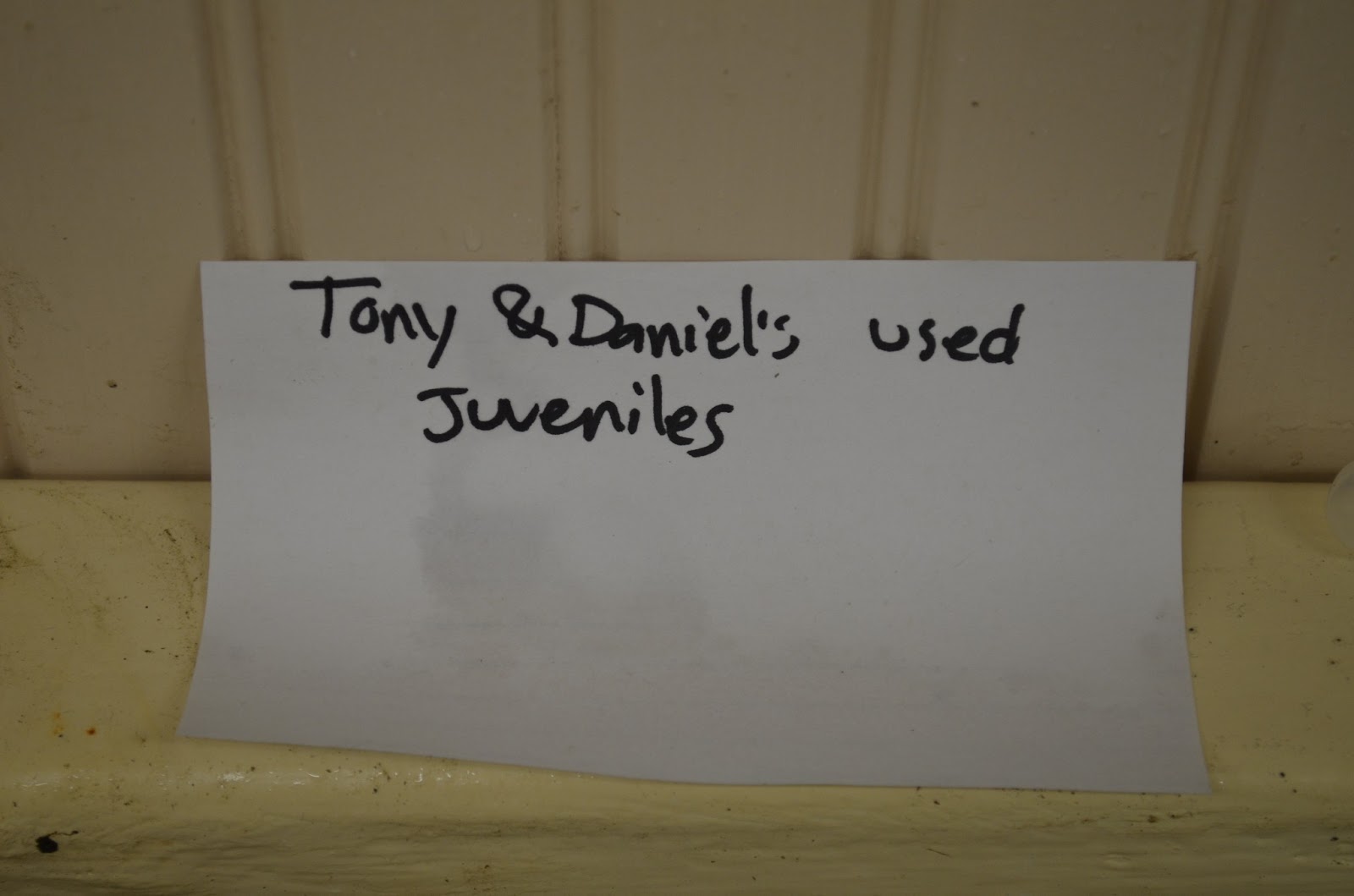
This is an interesting note, left above a bucket in one of the seawater tanks.  It's important to use research specimens only once so that any prior experimental effects won't skew the results.  The used individuals stay in the bucket until the end of the research day, and if Kristin and Lindsey don't need them for their seawater temperature experiments, Tony and Daniel take them back to the harbor where they were collected.


Here are a couple of other fun things from around the lab and nearby locations.  The photo below shows a large number of crabs feeding on a large clam that was given to them for food.  To give you an idea of scale, the crab shell is about 3" long.  The clam was put into the crab holding tank around 11am, and by mid afternoon the crabs had eaten almost the entire thing (except the shell, of course).


When I took a walk along the breakwater last night just before sunset this harbor seal jumped up onto the floating dock in the marina...


 ...and I saw lots of these little sea gooseberries (Ctenophores, comb jellies) being washed ashore by small waves, after which they rolled down the beach toward the water, only to be tossed back up again.


Last night we had a beautiful sunset.  This is a shot from the breakwater looking out to sea.


Stay tuned for more adventures of the first ever BYU-Idaho MBFE.

Thursday, May 23, 2013

Day 18 - "Shark Day"

Today's topic was another crowd pleaser - "Shark Day".  It's not really the same as Shark Week, because the goal of the day was to learn something, not just sit there staring at a screen saying "Oh Wow!"  Heh heh.

Anyway, we had class sessions after breakfast and again after lunch.  We spent about 90 mins in the morning going over a variety of topics regarding shark biology, anatomy, and evolution.  Then in the afternoon we took a more detailed look at about half a dozen shark species including White Sharks, Basking Sharks, Whale Sharks, Tiger Sharks, Bull Sharks, and Salmon Sharks.

Meanwhile, outside, it rained and rained and rained.  Well, it's Oregon :-)

And when we weren't having class, each member of the group continued working on research and photos for slide shows.  Only a few people went anywhere today - Jessica and Bailey collected plankton samples, and Dallas went with Blake while Blake took some photos.  Elysa, Mackenzie, Tony, and Daniel did more background research on the embryonic development of the sea slugs they are working with, and they found that one of the species they thought hadn't been done before actually had.  But it was published in a fairly small journal, so the paper that had that information is not available on-line.  They are now waiting for a copy of the paper to arrive via email through U of O interlibrary loan.  That paper should be here tomorrow or the next day.

Everyone is working hard learning a ton, in and out of class.

Sorry, there aren't any photos to show today...too much work, too much rain, and too little time.

Things are going fantastically well.  More next time.

Stay tuned.

Wednesday, May 22, 2013

Day 17 - 5/21 - More of the "fun stuff" plus, stand back, "I'm going to try science"

If you are just tuning into to the ongoing drama that is the first ever BYU-Idaho Marine Biology Field Experience, then you'll need to know that yesterday we spend about 3 hours learning about life in the nekton.  Today's topic was a follow up to yesterday's intro.  We spent about 3 hours today discussing the life and times of whales, seals, sea lions, sea turtles, sea snakes, etc.  The class loved it, though they do sometimes have a tough time keeping the old eyelids open during the class meeting after lunch.  That's OK, I get it.  After all, some of them are up the middle of the night collecting data and making other time-sensitive observations.

We have had absolutely fantastic weather so far this trip...but today a front moved through.  And we finally arrived in Oregon geographically AND climatically.  It wasn't bad though...after all, it's supposed to rain...it's Oregon!


I took a break after dinner this evening after working on lecture materials, and I popped over to the lab to see if science was happening.


Here's what I found at the lab:

Blake and Dallas were running experiments to see how dungeness crab larvae react to different colors of light.. 

Dallas and Blake were selecting juvenile crabs to use in the next run of their experiment...

And I'm here to tell you that having a hand-full of these little critters is a strange sensation.

Jessica and Bailey's work station for measuring chlorophyll concentrations was all set up and ready to run the the next day's samples.


Daniel and Tony's data were entered into a spreadsheet after the day's work.

Here's the experimental set-up for their substrate choice experiment.  Just FYI, it's a Randomized Complete Block Design.  You'll have to ask them about that.

Elysa, Mackenzie, Tony, and Daniel's larval cultures were in good shape in the seawater table...

...and the embryology station was ready for the next person's turn to check the cultures and record data.

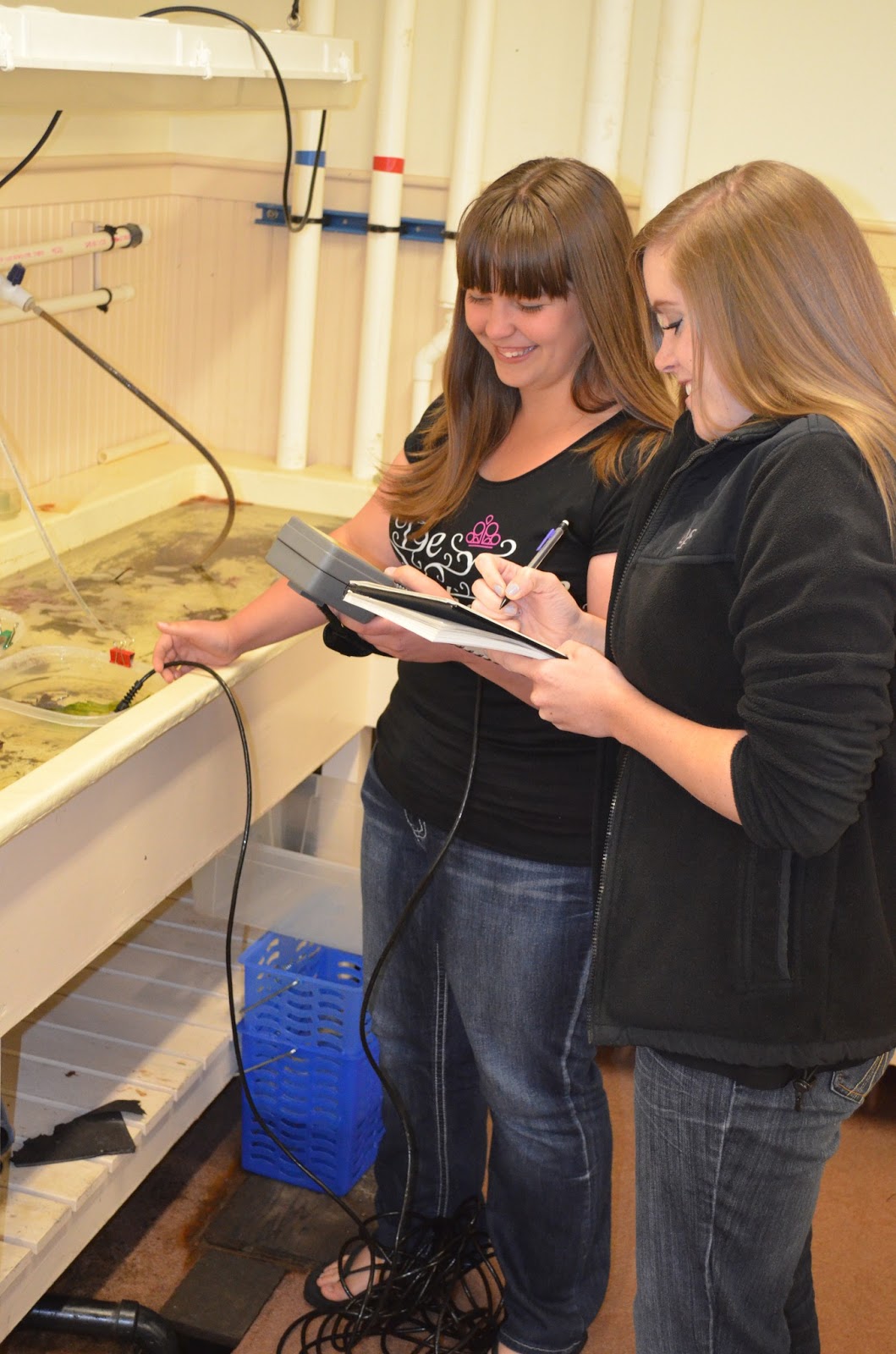
Lindsey (L) and Kristin (R) were collecting temperature and salinity readings as part of their work...

...and, yes, all of the students smile like this ALL THE TIME as they work.  You try it and see what it feels like when you generate your own data!

In the meanwhile Tony was hard at work uploading photos for a slide presentation each student is required to submit by the end of the course.

That was the action in the lab, so I strolled over toward the library...

Elysa and Mackenzie were hard at work in the library doing background reading and a literature search (again - way to go!) as part of their work for the sea slug embryology project.


So, yep, science is actually happening.  You might want to stand back!

That's a wrap for Day 17.

Tuesday, May 21, 2013

Day 16 - Finally, some of the "fun stuff"

You may have noticed that the posting so far have been dominated by topics like life in mud, sand particle size, and field trips to rocky shores, estuaries, etc.  Now that we have completed the planned field trips students are free to use the additional time to carry out research, travel to the field to collect data, and do science.

We will continue to have class meetings everyday, but the topics will focus on things that we cannot observe simply by taking a pre-planned outing.  Today was the first such class topic - "The Nekton".  Just FYI, nekton are animals that are big enough and strong enough swimmers to overcome tides, waves, and currents.    These are generally the kinds of animals that nature shows about the ocean are made of.

In the morning we spent about 90 mins discussing principles and adaptations for life in water for these large animals.  Then in the afternoon we spent about another 90 minutes discussing life history strategies of fishes.  Now do you wish you were here!?  :-)

After dinner we had our weekly discussion of scientific papers students have been reading, and at the risk of you nodding off to sleep, here are VERY brief summaries of what students shared:

1) Kristin - a paper about the effects of killer whales switching to preying on sea otters in the Gulf of Alaska
2) Jessica - a paper about phytoplankton in the flood plain of the Sacramento River as it makes its way toward the San Francisco Bay estuary.
3) Daniel - a paper about the embryonic development of the red sea slug Rostanga pulchra
4) Dalla - a paper describing the food web of the Ross Sea ecosystem in Antarctica and relationships between predator mouth size and preferred prey size
5) Mackenzie - a paper about the development of another sea slug, actually done by the director of OIMB
6) Elysa - a paper about a sea slug that eats algae but does not digest the chloroplasts.  Instead the sea slug keeps the chloroplasts and uses them for their own benefit.  Solar powered sea slugs?
7) Bailey - a paper on seasonal influences on phytoplankton populations
8) Tony - a paper on the dynamics of battle between different clones of the sea anemone Anthopleura elegantissima
9) Patrick - a paper on the behavior of intertidal hermit crabs
10) Lindsey - a paper on the effects of elevated water temperature on respiration in reef fishes
11) Tyson - a paper on the behavioral ecology of hermit crabs
12) Blake - a brief report on a dissertation on crab development and a student project paper about whether tide pool fish called sculpins can change their color in relation to background color

It was a good day.

There were no misadventures, and the research is moving forward.  Tony and Daniel spend the rest of the evening working on statistical analysis of their data.  Elysa and Mackenzie spent their time searching the literature to see if anyone had previously done what they are doing - embryonic development of sea slugs.

And that's a wrap.

Monday, May 20, 2013

Day 15 - Sunday #3

There's not a lot to write about Sundays...but it is so nice to be able to attend a ward here.  You know, being a member of the Church of Jesus Christ of Latter-Day Saints brings great benefits.  No matter where you are in the world where there is an organized unit of the Church, there is someplace you can go where you are automatically and immediately accepted.  You also know what will happen during worship services.

The members of the North Bend, OR, Ward have made us feel welcome, and it's been a pleasure to attend, worship, and learn with them.  Thanks North Bend!

We attended all three hours of the block of meetings and were still able to get back in time for lunch at OIMB.  The rest of the day is personal time.  Students used their time to do all kinds of things, including napping, taking a hike to Tunnel Beach - a beach accessed only via a tunnel that goes through the point of a mountain and is about the sizeof a RR tunnel, and playing a board game.  Of course, some students had to pop into the lab to collect time-sensitive data and do basic maintenance of animals they are keeping there...you know, just like farmers who have to feed the stock,. even on Sundays.

The game players included Bailey, Jessica, Daniel, Dallas, Lindsey, Kristin, Tony, and me (Dr Holyoak).  We played the 6-player expansion of "The Settlers of Catan" (OK there were two teams of two, and it was the first time for some of the players).  Tony bushwhacked us at the end and walked away with the game when he built a stack of roads and took the Longest Road card.  Way to go Tony.


We had FHE after dinner, and Mackenzie gave a good thought for us, followed by additional comments from Lindsey.  I then complemented the group on how well they are doing, how well they are getting along, and how hard they are working.  That led to the parable of the Cheetos...

OK, it's like this.  I used this story to hopefully help everyone avoid tiffs or spats that just don't need to happen.

When I was in graduate school, before I was married, I was invited to share a townhouse with a fellow graduate student who was looking for a housemate.  His family owned a nice townhouse in a gated community in Santa Cruz, CA - nice!  The family didn't live there, so it was just the two of us, and all I had to pay each month was the homeowner's fee...a few hundred dollars...a real bargain in Santa Cruz.

I moved in and things were going quite well.  About now you should know that my favorite salty, crunchy snack is Crunchy Cheetos.  I had some soda in the fridge and a new bag of Cheetos in my food cupboard.  I came home from a full day at work, pulled out a soda, reached for my Cheetos, and saw that they were open and about half gone.

My knee-jerk reaction was, "That slimy snake!  He's been eating my Cheetos!!!"  I was ready to get on the warpath.  My housemate wasn't there, but I was getting ready to lower the boom on him when a thought came to mind.  It was this, "Wait a minute.  You have a pretty sweet deal here.  You live in a super nice townhouse, and all is costs you is a monthly homeowner's fee and half a bag of Cheetos."  I sat back and though, "Huh!  That's right."  So I never said a thing about it, and it never happened again.

To this day whenever I'm faced with some small inconvenience or interpersonal problem I often think to myself, "Hey, don't sweat the Cheetos", and that cuts the problem down to size.  This has helped me to avoid many confrontations that just aren't worth it.

So, DON'T SWEAT THE CHEETOS.

After the FHE thoughts and discussing the next day's schedule we played several rounds of a fun card game, "The Great Dalmuti".  It's a good game for around a dozen people.

Then those who wanted to, stayed on and watched the movie, "Chasing Mavericks".  If you haven't seen it, it's well worth your time.  It's awesome.


And that's a wrap for Sunday #3 of the BYU-Idaho MBFE.

Saturday, May 18, 2013

Day 14 - Two weeks in, halfway through...and "There be whales here!"

The BYU-Idaho Marine Biology Field Experience (MBFE) hit a landmark today - on 18 May we will be halfway through our time at the Oregon Institute of Marine Biology.

Students spent the morning doing research, followed by class at 11am.  After lunch Patrick and Ty went back to South Cove, Cape Arago, to check on their hermit crab experiments, and then at 3p we had a second session of class.

At 4pm the class attended the weekly OIMB seminar.  This week's seminar was given by a fisheries biologist from NOAA (The National Oceanographic and Atmospheric Administration) based at Humboldt State University, Arcata, CA.  He talked about frontal boundaries between different masses of ocean water and their effects on larval and juvenile rock fishes.  It was pretty interesting.

The main excitement today was when the words "whales sighted" were uttered in the Dining Hall right after dinner.  A U of Ore student told me he'd seen whales just outside of South Cove, Cape Arago, about 30 mins earlier.  You've never seen a group of college students move faster.  Before you knew it, they emerged from one of the buildings toting spotting scopes, binoculars, and cameras.  And we were off to Cape Arago to see what we could see.

We were initially a bit disappointed when we didn't see anything at the Middle Cove observation point, but I spotted whales when we could look into South Cove. The students sprinted over.  Before long everyone was spotting whales blowing.  We counted seven gray whales, including at least two calves.  They are majestic creatures.  We watched them for 45 mins to an hour as they worked their way up the coast.

Gray whale blowing
Cape Arago, Oregon, May 17, 2013
(c) 2013 Alan Holyoak

The students were so excited to see these whales...I mean, who wouldn't be?  It was extremely cool.

I know I took several photos of the group watching the whales, but for some reason not all photos transferred to my computer last night, and I deleted the photos from my camera without double checking - DOH!  You only learn when you lose, I guess.  Sigh...

At least a couple of the sunset shots I took just before we came back to OIMB transferred over.  Here's a particularly nice one over Simpsons Reef, north of Cape Arago, Oregon.

Sunset over Simpsons Reef, Oregon
May 17, 2013
(c) 2013 Alan Holyoak

PS - You will be happy to hear that Dallas' extra car key arrived today, and all is well.