Showing posts with label plankton. Show all posts

Saturday, May 18, 2019

MBFE - Weds 5/15 - A three hour tour, and three hour tour...

We had a full day including an outing on the research boat in the morning and looking at plankton we collected on the boat in the lab in the afternoon.

The only class field trip we had had left to do was to go out on the U Oregon research vessel RV Pluteus and collect plankton samples and do some bottom trawls to see what we might get there.
Today was that day!

Here we are at 8am, geared up and ready to depart.

Here's the team (L-R): Dr. Holyoak (on dock), Sam, Eric, Victoria, Michelle, Cale, Collin, Matt, Liv, Chey, Jenn, Maddie, Hunter, Emma, Anne, Ben.


This is the Oregon Institute of Marine Biology's main research vessel, the RV Pluteus.  Pluteus, by the way, is a larval stage of a sea urchin.  

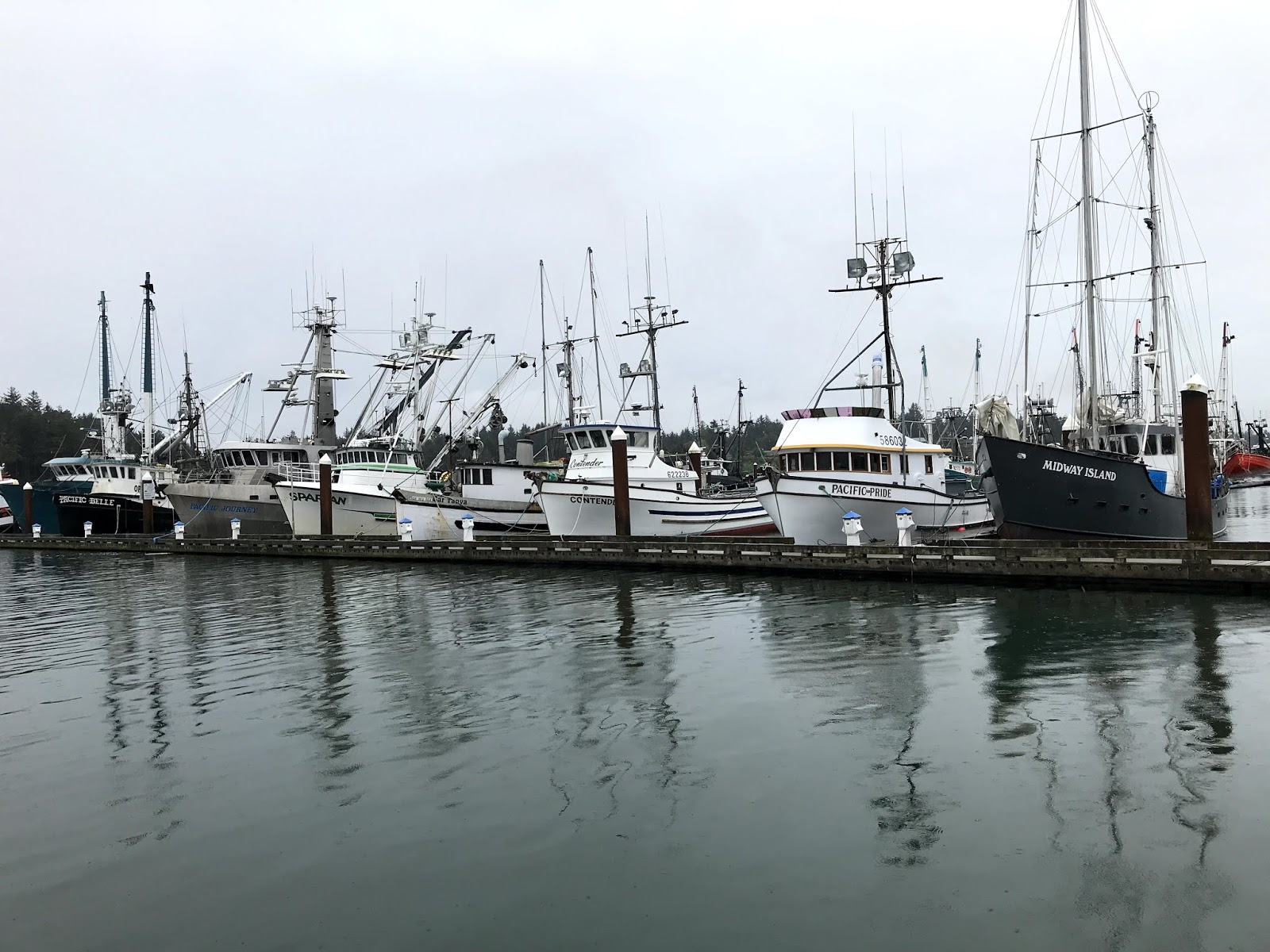
Before departing, Captain Knute welcomed the group and gave some safety instructions.  And we were off!  We passed some of Charleston, Oregon's fishing fleet as we left the harbor.  Charleston is a commercial fishing port, and a fish processing plant is actually right across the street from the OIMB.

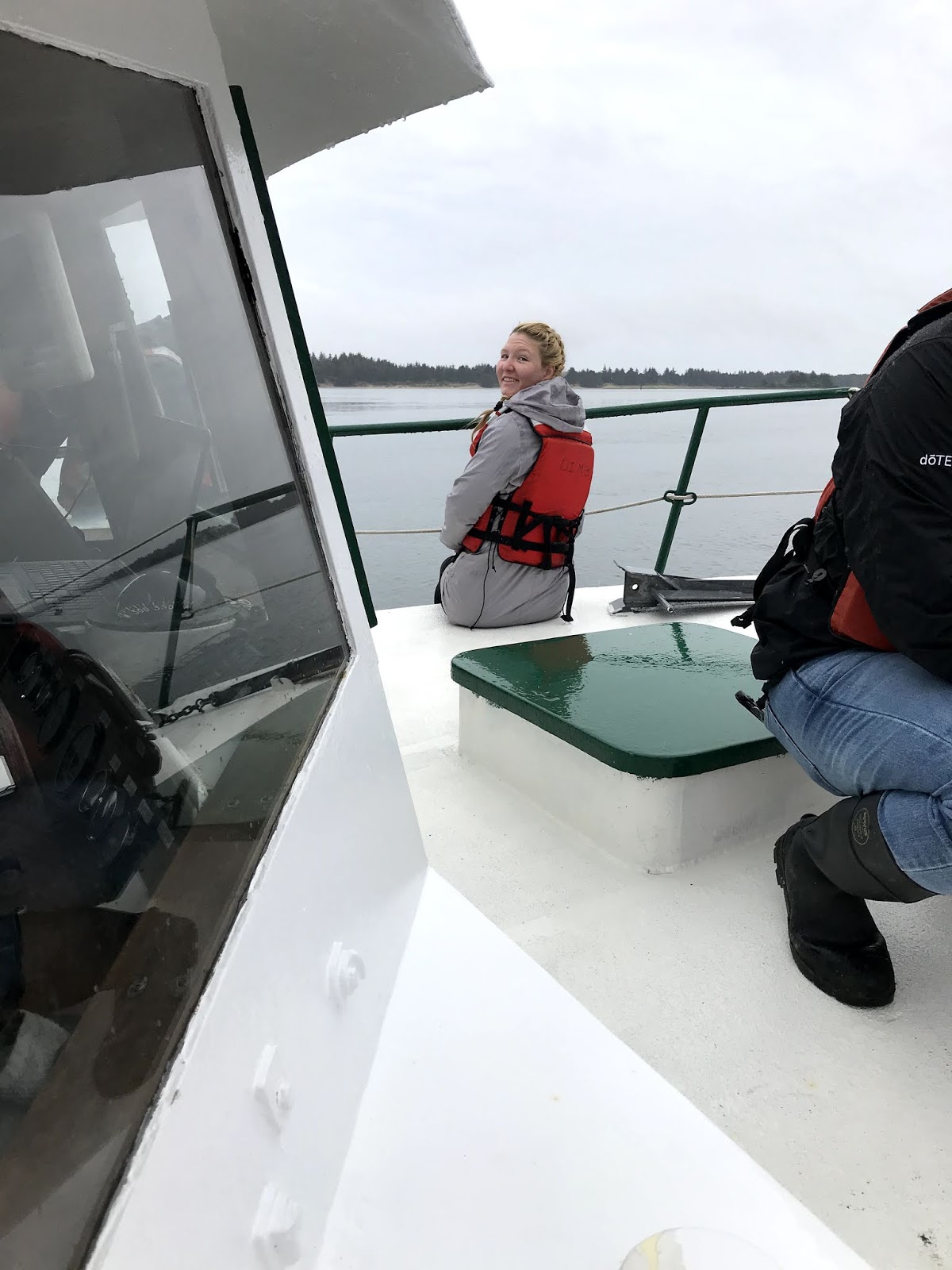
It was a gray, overcast but calm morning as we headed out onto the bay.  The wheelhouse on the boat is fairly small, so most of the time most of the students were out on deck (me too).  We did not need to leave Coos Bay to do what we needed to.  That was nice.  We were on relatively calm water and didn't have much wind either.

Here are (L-R) Ben (turned away, Jenn, Eric (background), and other mystery students hooded up.


Meanwhile on the foredeck, Hunter, Caleb, Matt and Anne took in the sights as we headed out.


As did Chey, who was also up there.

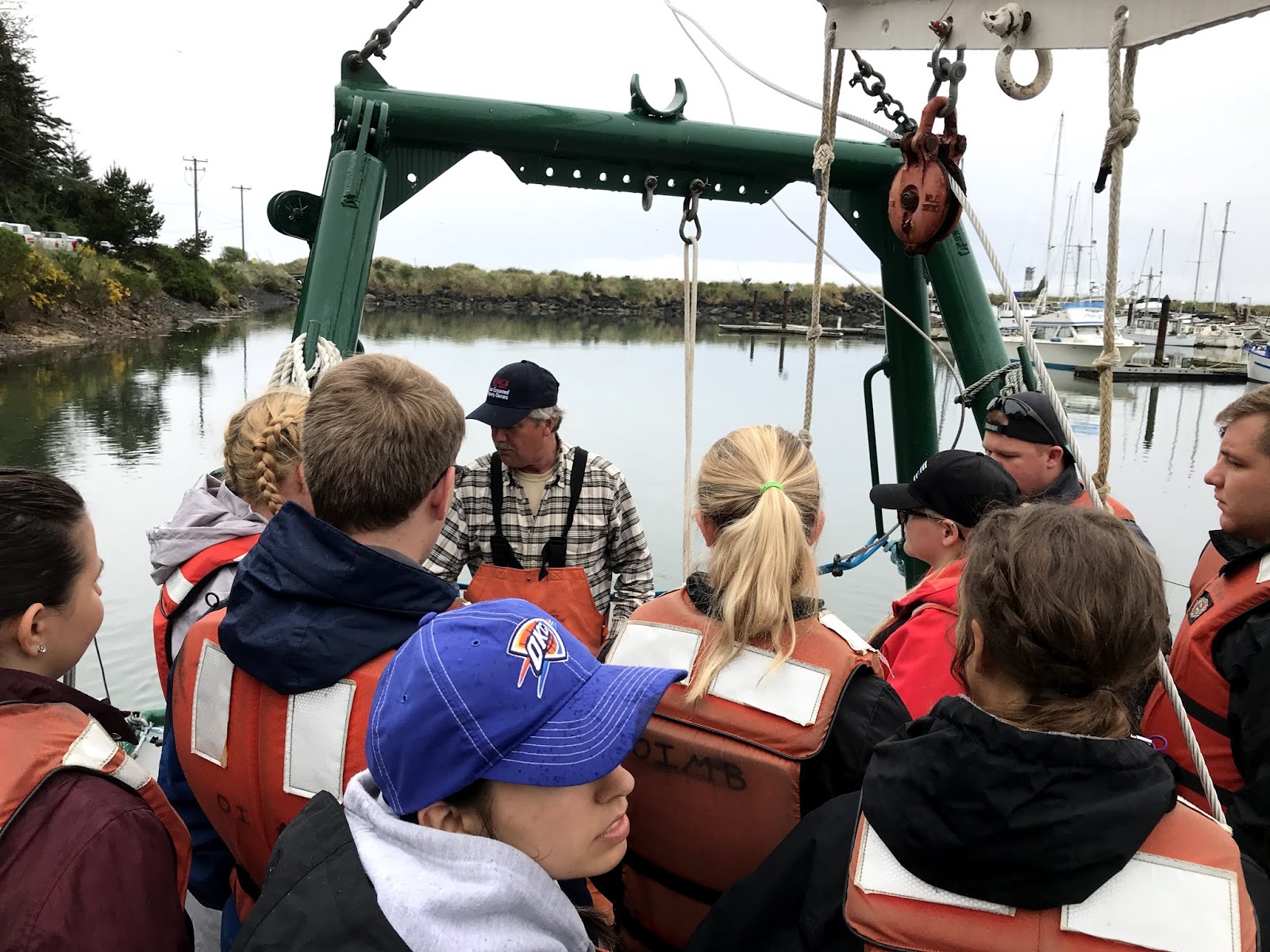
Once underway, Capt Knute had time to chat with our group.  Here he is with Ben.


Our first task was to deploy the plankton net and collect plankton to take back to the lab.  A plankton net, at least the one we used, was perhaps a meter in diameter.  After pulling it behind the boat for a little while we needed to haul it in and put the sample in jars.  We did two plankton tows.  

Michelle is pulling in the plankton net as Victoria looks on.


Shortly after we left shore, it started to sprinkle and then to rain.  Up went the hoods and people started to shelter under the aft overhang of the wheelhouse, but spirits and morale remained high.  Here are (L-R) Collin, Chey, Maddie, Emma and Michelle.


And toward the stern were (L-R) Matt, Jenn (facing away), Eric and Sam.

In this photo should note that the wire cable coming off of the winch is taut. This means that we were in the middle of a bottom trawl using an otter-trawl net.  

And the rain kept on coming down...


When it was time to retrieve the net, someone has to guide the cable back onto the spool so it goes side to side and doesn't wrap up too much in one place.  Liv volunteered to do that job of a deckhand during one of the retrievals.


We attempted two bottom trawls, but, alas, the net was fouled and we didn't get any samples either time.  So, sadly the efforts to bottom trawl were a bust.  By this time many in the group were wet and chilled so we headed back in.  By the time we docked we'd been been out for three hours...just like the crew and passengers of the SS Minnow (Gilligan's Island), except we made it back to shore a-okay!

Here were a couple of nice finds.  This first one is something that I'd know about for a long, long time, but I'd never seen a live one.  This is a planula larva of a cnidarian, possibly a sea anemone.  If successful, it will settle down someplace and metamorphose into a juvenile anemone or some other kind of cnidarian.


If you look carefully in the center of this photograph you'll see something that looks like it has clusters of needles sticking out of it.  It is a larval annelid worm of some kind.  It will eventually elongate and start adding segments.  It will then settle out of the water and become a juvenile worm.  Very cool stuff, right?


By the end of the afternoon we were all pretty well bushed, and ready to rest up for the next day.

This outing was the last of our scheduled marine biology class field experiences.  From now on we will still have daily lectures and the rest of each day will be devoted to student research.

MBFE - Monday and Tuesday 5/13-14 - Lecture and research

Sorry this posting is not particularly action packed, but some days are like that.  But wait until the next posting...

Yep, we have reached that stage of the MBFE where our days are now taken up by one lecture each day and the rest of that day is devoted to research.  So, there's not a lot to tell about Monday 5/13, except that we spent about 2.5 hours in the morning learning about the plankton community.  On Tuesday our topic was shallow water benthic communities, like soft-sediment habitats, kelp forests and seagrass beds.

We did this in preparation for our final class outing - a trip on the University of Oregon's research vessel, the RV Pluteus, but that's a tale for the next posting.

The research teams are getting underway nicely.  More on that another time.

Stay tuned!

Tuesday, May 16, 2017

MBFE - Day 21 - Out to sea

Days 19 and 20 were a Saturday and a Sunday, largely free time for members of the MBFE.  They did research that needed to be done and then enjoyed some down time.  We attended the Coos Bay Ward again and had a fun Home Evening.  Bri gave the thought.

Day 21 was full, full, full!

The morning of Day 21 each research team was back at it full steam.  Some members were working in the field, others in the lab.  I took time to touch base/check up on each group to make sure they were doing all right.

Just before lunch I crossed paths with "Captain Mike". OIMB's chief boat captain.  He told me that he could take our group out on the boat to do some bottom and plankton tows.  The weather was great. It was windy but sunny!  The MBFE crew's spirits were high as we boarded the RV (Research Vessel) Pluteus.  Pluteus is the name of sea urchin larvae.

Here's the group before we left the dock.


Here's the whole crew (L-R) Dr. H, Stephen, Wyatt, Katie (front), Janae (behind), Harrison, Courtney, Rob, Darby, Emily, Bri, Jay, Darren, Caitlin, Ashley.

Fifteen passengers set sail that day for a three hour tour, a three hour tour...(sound familiar?)

We had a great outing.  It was fun being on the water and the class really enjoyed seeing this aspect of marine biology.  We did a couple of bottom dredges and a couple of plankton tows.  

Here are a few shots of the crew while we were out.

Students were able to all the deck work while we were out.  In this shot Wyatt is running the winch and Courtney was monitoring the dredge during the tow.  (L-R) Rob, Bri, Wyatt, Courtney, Darren,  

(L-R) Bri, Wyatt, Courtney (foreground), Darren, Ashley, Caitlin and Stephen.


Another shot of the working deck (L-R) Katie, Rob, Darby, Janae, Emily, Bri, Wyatt.

You aren't surprised when a bottom tow produces a haul of sand dollars, but this time it offered up other sea change...looks like a sand quarter, a couple of sand nickels and a sand dime (Emily).

Harrison (foreground) monitors the dredge during another bottom tow.  Others are (L-R) Katie, Emily, Janae, Darren, Wyatt, Rob, Captain Mike, and Ashley. 

Also on deck are (L-R) Rob, Captain Mike, Ashley, Courtney, Stephen (back) and Bri (front).

It was fun to see what was in the bottom drags.  It's like Forrest Gump's mother says, "Life's like a box of chocolates, you never know what you are going to get." (L-R) Stephen, Ashley, Caitlin (fore), Courtney (back), Harrison (on the cable), Jay, Katie, Emily, Rob.

Stephen and Emily look at a sample from the plankton tow.  

Though we'd already had a busy day we pulled out the microscopes as soon as we got back to the lab to see what we could see.  It was a fantastic sample!

This shot highlights a couple of arrow worms - sharks of the plankton.

This was a real score.  I hadn't seen one of these in real life before - it's an Appendicularian.  It's a tiny tadpole shaped animal that's actually a distant relative of ours, it's an invertebrate Chordate.  It usually lives in a mucous house that it secretes, but it bails out when disturbed.  A plankton tow definitely counts as a disturbance!

This is a larval fish.  Larval fishes are TINY!

This was a great, though tiring day.  Missions accomplished!  The students (and I) loved it.

Saturday, May 6, 2017

MBFE - Day 10 - Plankton races and Star Wars Day

We spent time in class today discussing life as plankton, including what Reynolds Numbers are and what they mean, and considering plankton body shape and its effect on sinking rate.  That's when I remembered a lab exercise I'd been toying with and decided it was the perfect time to try it out.

Each student received 5g of plasticene clay and were told to use it to make an object that would sink as slowly through the water as possible, that is, to make up a plankton shape.

While they were doing that I filled a glass cylinder that was in the lab.  It was maybe a foot across and a couple of feet tall.  I then told the class that we were going to have plankton races...the object that sank slowest wins.  There was a bracket and plankton went head-to-head in matched pair races.

The principle suggests that the plankton with the largest surface to volume ratio should sink the slowest.

Many of the shapes that students came up with were variations on large, flat discs.  This is indeed a way to increase surface to volume ratios, and the games were on!

There was a lot of cheering, a little competitiveness and lots of fun as plankton sank in best two of three contests.

Here are the results of round 1:
 It was Jay and Janae in the finals, and the winner was?  Janae!

I then looked at the designs and realized that if these were zooplankton that there would not really be enough room inside for their internal organs, so I then gave each class member a small plastic vial that represented the planktons' bodies.  They then had to build their overall form around that.  And then we raced again.

Here are the results of round 2:
It was again Jay and Janae in the finals, and the winner?  Janae!  Again!!

As those of you who know Janae would have guessed, she accepted victory with the dignity and modesty she is well known for.  (Ha ha)

And that was Day 10!  Or was it?

How could I forget to mention this?  Day 10 of our trip was May the 4th.  And in some circles this qualifies as a major unofficial holiday - "STAR WARS DAY!" 


So that evening the students were all invited over to my cottage where we watched "Rogue One" and snacked on goodies like "Chewie Chip Cookies", "Yoda Soda", "Ham Solo" (little sliced ham rolls), "Leia hair buns", etc.  It was a great time and just about everyone joined in.  My wife was right, we are a bunch of nerds!  And happily so.

Saturday, May 16, 2015

MBFE - Day 24 - By-The-Wind-Sailors continue to wash ashore in the millions

We had our last BIO 314 lecture on Tuesday 5/12 so students have shifted to full-time work on their research, writing, gathering photos for a class assignment, and getting their field/research notebooks ready for evaluation early next week.

The By-The-Wind-Sailor Velella velella appeared in one of the early MBFE 2015 updates, but students and I remain shocked at the vast number of these little animals that keep washing ashore along beaches near us.

Velella is related to animals like sea anemones, jellyfish, and coral.  They have an upright sail that allows them to tack away from the direction of the wind and normally avoid shore.  As they drift they dangle tentacles into the water and capture small plankton that they use for food.

On Bastendorf Beach, only a mile or so south of the marine lab, you can see even more of these lovely little animals along the entire length of the beach.   


In some places they are stacked several deep on the sand.  Sadly, ones that wash ashore die.


Velella are, thankfully, not dangerous to bare feet.  It's impossible to avoid these if you want to walk the beach near the water, and they are disturbingly squishy.


The appearance of hoards of these animals appearing on west coast shorelines is not at all unusual, so there is no cause for alarm, though this is amazing.

We are on track and doing great.

Stay tuned for more updates.

Tuesday, May 7, 2013

Day 4 - Of things small and most curious...plankton day


Not all class days can or should be 15+ hours long.  So today was a bit lighter.

The word for the day is “plankton”.  Plankton are little creatures so small or weak that they cannot overcome currents.  If you recall, at the end of Day 3 we collected 100s of larval crabs.  


Megalops stage of Dungeness crabs Cancer/Metacarinus magister
(c) 2013 Alan Holyoak 

The first order of the day today was to take a close look at those crab larvae and the juvenile crabs they metamorphose into…and there was a lot of metamorphosis going on.  This was a prime opportunity for the class to see things that few people ever see firsthand.  So with scopes on the lab benches and pencils at the ready, they dove into looking, drawing, and thinking about crabs. 

RL: Elysa and Mackenzie

Tony 

Blake and Kristin

 
 LR: Jessica, Bailey, Daniel, Dallas

Our teaching lab at OIMB

During the middle of this session Craig Young, Director of OIMB, popped in to see if we were here and how we were doing.  I’ve known Craig for, yikes, close to 30 years.  He has been inviting me to come to OIMB for the past several years.  I’m so glad that we finally made it.  Anyway…

After about an hour with the crabs it was time to move onto lecture material for the day.  We spent about the next 1.5 hours going over structure and processes of plankton communities including everything from marine viruses and bacteria to large plankton like krill and jellyfishes. 

With a good dose of theory in our bellies we needed a break, so we went on plankton safari to the Charleston, OR, marina, and with plankton net and dip buckets in hand we were off.
Unfortunately there were no jellies to be seen, so we had to rely on the plankton net for samples.   That’s OK, and we finished collecting samples just in time for lunch.

 Off to the Charleston, OR, harbor

Tony does a plankton tow. 

 The crew takes a look at life on the docks

After lunch we finished our lecture material for the day and walked down to the pier by the Boat House at OIMB to collect more plankton, we hoped.  Then it was time to go back to the lab.  Students pulled out the scopes and got to work seeing what they could see.  They say larval worms, snails, crabs, copepods, and barnacles, along with diatoms and other things.  It’s always an adventure to see what tiny creatures abound in a drop of water.

Off to the OIMB Boat House pier to do more plankton tows.

Lindsey take a turn collecting samples.  Blake and Tony look on.

That work went right up until dinner…and we had a short meeting to discuss the next few days.
We had a short group meeting at 7p to discuss the next few days.  There’s good news and there’s bad news.  The good news is that we will have negative low tides for the next several days.  The bad news is that tomorrow the low tide is at 6am.  Heh heh.  We plan to leave at 5:45 am to work this low tide.

By the way, the crew decided to head back to the harbor tonight to see if the megalops crab larvae are still there.  They might be a very nice little research organism for a team or two to work on.  

Oh well, if students wanted to sleep they could have stayed in Rexburg, because when the tide’s low we go!