Showing posts with label Charleston. Show all posts

Tuesday, May 19, 2015

MBFE - Days 26-28 - Sneak peak at the Charleston Marine Life Center

I think it's safe to say that the MBFE crew spent most of Saturday working on their research presentations and their laboratory and field notebooks.  They were due today (Monday 5/18) at 5pm.

We did take a break during the afternoon though and were treated to a sneak peak at OIMB's Charleston Marine Life Center (CMLC).  This is a combination aquarium and educational facility scheduled to open to the public in August 2015.  Dr. Craig Young, Director of OIMB invited us to take a look at how it's coming along.

L-R: Rachel S, Skyler, Shannon, Jennifer, Arianne, Dr. Craig Young, Kelly, and Jessica just inside the front door of the CMLC.


Two of the main exhibits at the CMLC are mounted skeletons from a real gray whale (upper) and a killer whale (lower).  Both died near the Oregon Institute of Marine Biology and have been in storage for years, now they have a place to be on display.  Impressive!


We had a chance to do many things that regular visitors will not be allowed to do - that's always fun.  for example, we got to handle the teeth from the killer whale skeleton.  The teeth in the mounted skeletons are models of the real teeth,  This was done for two reasons.  Dr. Young told us that first, killer whale teeth eventually crack, and second, that because killer whale teeth are ivory he did not want to run the risk of someone trying to climb up and remove teeth - dangerous to the skeleton and the potential thief. (L-R: Joseph, Rachel S, Orcinus orca, Dr. Young, Kelly and Skyler).


Look at the size of these teeth!


Rachel S., Rachel M, and Joseph take a closer look at those chompers. Luke and Courtney chat in the background and Devon and Jennifer look at a display in prep in the far right background.


Then Dr. Young help up a display cover so that students who wanted to could feel a real sea otter pelt - one of the most prized types of fur in the late 1800s.  Courtney gives it a try while Jennifer and Shannon look on.  I touched it, and that fur is dense and soft!  It's too bad that sea otters were nearly hunted to extinction.


Here Dr. Young introduces the MBFE to a display that when complete will cover dolphins and toothed whales (L-R: Rachel S, Dr. Young, Skyler, Kelly, Joseph), and Courtney and Luke look at a sperm whale skull to the right).


Shannon, Jennifer, and Isaac chat after looking at the sperm whale skull.


Dr. Young is a great host, and we thoroughly enjoyed our time at OIMB (Dr. Craig Young, left, Dr. Alan Holyoak - MBFE Director, right)


Time to go...


Saturday, May 16, 2015

MBFE - Day 24 - By-The-Wind-Sailors continue to wash ashore in the millions

We had our last BIO 314 lecture on Tuesday 5/12 so students have shifted to full-time work on their research, writing, gathering photos for a class assignment, and getting their field/research notebooks ready for evaluation early next week.

The By-The-Wind-Sailor Velella velella appeared in one of the early MBFE 2015 updates, but students and I remain shocked at the vast number of these little animals that keep washing ashore along beaches near us.

Velella is related to animals like sea anemones, jellyfish, and coral.  They have an upright sail that allows them to tack away from the direction of the wind and normally avoid shore.  As they drift they dangle tentacles into the water and capture small plankton that they use for food.

On Bastendorf Beach, only a mile or so south of the marine lab, you can see even more of these lovely little animals along the entire length of the beach.   


In some places they are stacked several deep on the sand.  Sadly, ones that wash ashore die.


Velella are, thankfully, not dangerous to bare feet.  It's impossible to avoid these if you want to walk the beach near the water, and they are disturbingly squishy.


The appearance of hoards of these animals appearing on west coast shorelines is not at all unusual, so there is no cause for alarm, though this is amazing.

We are on track and doing great.

Stay tuned for more updates.

Friday, May 15, 2015

MBFE - Day 22 - Baby Squid!

Things continue to go well with the MBFE.  The students have jelled well as a group and as far as I can tell there haven't been any significant conflicts or issues.  Maybe I just got lucky with the mix of participants.  Then again, there is something soothing, healing, and a little like coming home when we visit the sea.  Being able to sit and watch the waves roll in and see the tides rise and fall tends to calm us and our souls.

OK, the big happening today was that someone  took time to look at a mass of squid eggs that we've had in culture in the lab since April 25th, and they saw baby squid swimming around!

Where did the egg masses come from?

During our down time, on Saturday afternoon April 25th I went to Lighthouse Beach just to poke around.  At the south end of that beach is a rock wall and some rock pools.  I noticed something very odd on those rocks.  There were oblong, translucent, gelatinous masses all over the place.


I thought at first that they might be squid egg masses, but there were so many of them that this would have been extremely strange.


I picked up a clump of them that had been attached to some sea grass but somehow washed up on shore.  Yep, they were squid eggs all right!  I didn't have anything with me to put them in so I just slipped them into my jacket pocket and walked on.


I walked on and looked down at a large tide pool and saw that it was FULL of egg masses!  They were not only here but also all over floating in the water and all over the rocks.  This represents MASSIVE reproductive failure by these squid.  I talked to faculty at OIMB where we are based and they'd never seen anything like it either.


The egg mass I collected was soon put into a beaker in the lab and everyone took a look at them. Squid embryos take weeks to hatch, so there was no guarantee that we'd see anything.  After a week or so of checking we all forgot about them...well, I did change the water once in a while and plopped an aeration stone in it.

Two and half weeks later someone took a look and there were baby squid jetting around in the beaker!

Did you know that you can take quite nice photomicrographs with a cell phone camera?  Just line the lens up with an eye piece and snap away.  Here's what those babies look like:


There were, I have to say it, squeals of delight from some students, and everyone anxiously took a good long look.  

It was super-cool!  If you looked at one long enough you could see its chromatophores (the brownish spots) dilating and contracting, you could see the hearts beating inside the mantle, and the mantle muscles contracting as it tried to jet around.

Now that's not something you see every day!  Welcome to MBFE - you never know what you'll see next.

Tuesday, May 5, 2015

MBFE - Days 12-13

Day 12 - Saturday May 2nd

Just like last week we had class on Saturday morning.  We spent that time discussing the nekton - organisms that are strong enough swimmers to overcome currents.  You know, mainly fish, squid, and marine mammals.  I then cut the crew loose for the rest of the day and weekend.  It's important to have some down time each week.

Students scattered to get to work on research, do laundry, hike, play volleyball at the lab's sand volleyball court, etc.  I took a short hike to an old RR tunnel not far from the lab.  It was pretty cool. Here are a few photos from that outing.

You go down a short but steep trail.  Partway down the trail you catch a glimpse of a broad algae-covered rocky shelf.  It's beautiful.  Coastal Oregon seldom fails to please.


The mouth of the tunnel appears as you round a corner.  As you can see, it's not that long - you can see the other end of the tunnel in this shot.


The shot below is looking back out of the tunnel mouth, and the one below shows the opening at the far end.  It's not a long walk to get to the other end, but there were several places where I saw rock that had come down recently, so be aware as you walk through.


Here's the scene at the far end of the tunnel.


Though not shown in this photo, if you could see farther to the left you could see another tunnel. These tunnels were built during the early 1900s when the south breakwater protecting the mouth to Coos Bay was built.  It was extremely difficult to get equipment and materials in place to construct the south breakwater so the Army Corps of Engineers built the tunnels and a rail spur line through them to deliver those things to the construction site.

The photo below shows the entrance to Coos Bay.  The south breakwater is the one on the right-hand side of the photo. 

(Photo courtesy of  FLICKR/ ALEX1DERR)

The trestles are now all gone, but the tunnels remain.  It's pretty cool!

Day 13 - Sunday May 3rd

The crew had more down time after Church. Then at 7pm we had our weekly group FHE.  Rachel S gave a thought, we played a version of Apples to Apples, and then students were invited to stay for a Sunday evening movie, "The Big Year".

It was another fantastic week.  Stay tuned for more updates.

Thursday, April 30, 2015

MBFE - Day 10 - A three-hour tour near the mouth of Coos Bay


"Just sit right back and you'll hear a tale, a tale of a fateful trip..." (from the Ballad of Gilligan's Island)

The photo above is this year's official MBFE group photo.  L-R: Dr. Holyoak (on dock), Arianne, Rachel S., Eileen, Skyler, Isaac (back), Devon, Kelly, Jessica, Rachel M., Danielle, Courtney, Jennifer, Shannon, Luke, Joseph.

This is Captain Larry.  He always gives a safety briefing before departing.  He took good care of us, he's retired Coast Guard.


It's easy to see that the class enjoyed the outing. L-R: Arianne, Kelly, Shannon, Jessica


L-R: Isaac (back to camera), Joseph, Devon, Jessica, Kelly, and Luke


L-R: Courtney, Danielle, Rachel M, Isaac, Joseph, Devon, Arianne


L-R: Arianne, Eilen, Isaac, Luke (over Isaac's shoulder), Danielle (background), and Skyler.

Because Capt Larry was piloting the boat students worked the deck (under his direction).  In this photo Isaac is working the winch that lowers and raises the small trawl net we used to collect specimens.  L-R Courtney, Danielle, and Rachel M look on.


Here are L-R: Kelly, Jennifer, and Skyler retrieved a net full of shells, crabs, fish, and other things.


Later Jennifer tried her hand on the winch.  Yep, she's NOT having fun.


 Skyler and Arianne retrieved the net this time.


Skyler is a real "fish guy" so he was happy to make the acquaintance of this flatfish.  You can tell he's thrilled by the look on his face.


Midway through the trip Capt Larry took us close to a beach with around 100 harbor seals, here are a few of them. 


On the way back to port Eileen, our group's bird enthusiast, was treated to some nice sea birds


Here's a pelagic cormorant (it's actually got a small fish in its bill).


Here's a shot of a pelican during take-off.


And these gulls followed us for part of the outing...they love to do this, just in case there's a chance that some scraps or other things that they might be able to swoop down and scoop up.


About three hours later we were back in port with great experiences had, memories made, and friendships deepened.

Stay tuned for more adventures.

Wednesday, April 29, 2015

MBFE - Day 9 - Docks Piers and Piling Communities - Oh My!

The MBFE adventure for the day today (Weds 4/29) was to discuss dock, pier, and piling communities in the morning, then to walk to the Charleston Marina and explore them.  We expected to see lots of marine invertebrates and algae growing below the water line on the docks, and we were not disappointed.

Here are some shots of the crew checking out the life on the docks:


Eileen and Isaac are on the dock in the foreground with Skyler hanging over the dock in the background.


Here are L-R Rachel M, Danielle, and Courtney...

Rachel M is standing on the dock in the background with Danielle, Isaac, and Courtney lying down, with Skyler in the foreground.


Here's Jessica getting a good close look at the dock community.

Here are a few things we spotted:

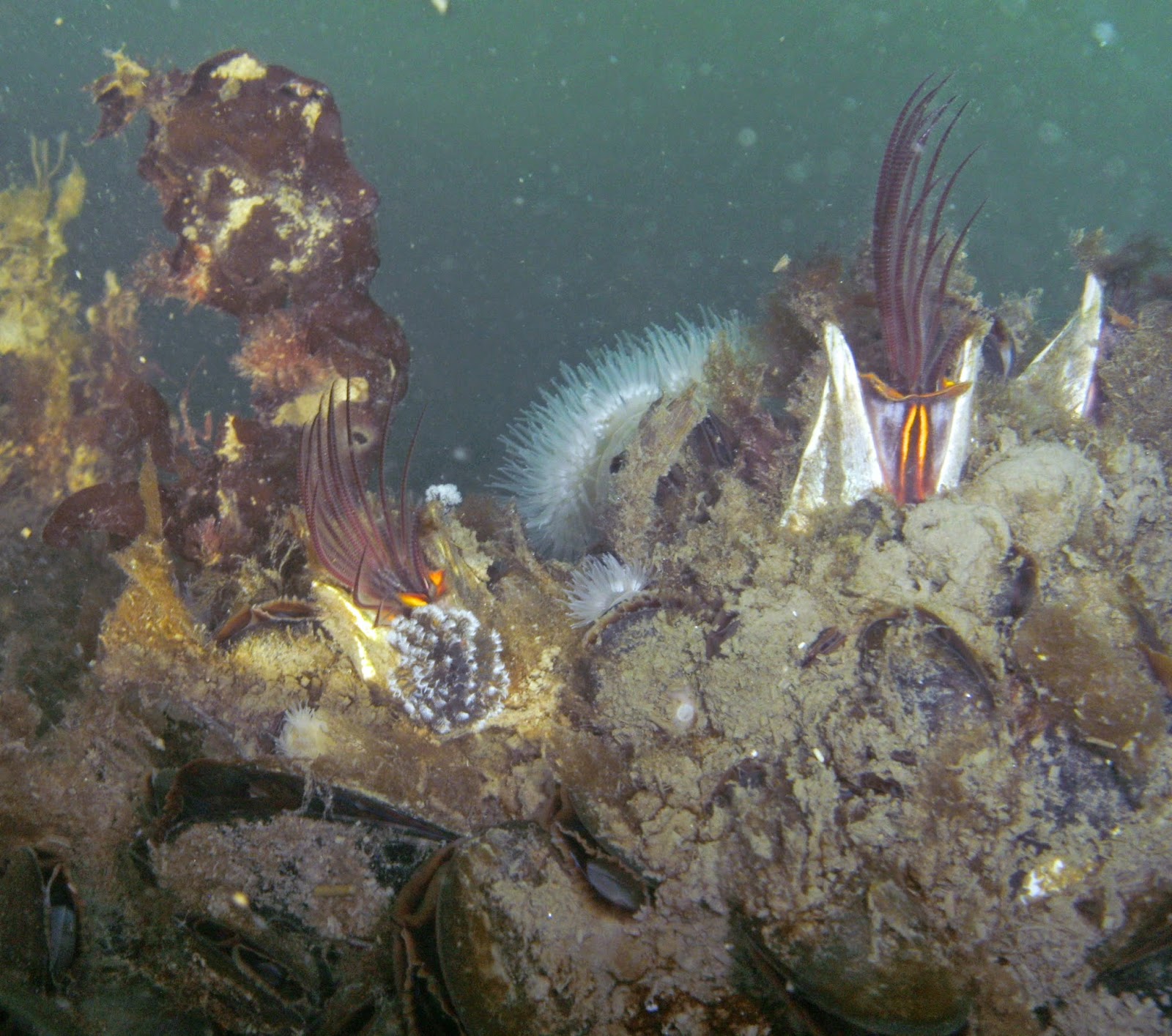
Giant barnacles Balanus nubilus...


...sponges and small thread-like caprellid sprimp...


...more sponges and tube worms...


...giant green anemones...


...and smaller white anemones among other things...


What we DID NOT expect was that while we were hanging over the edge of the dock with our faces within inches of the water that we would be observed by something else...

A class member was hanging over the end of a dock and there was a large splash right next to them - it was a harbor seal.  Shortly after that I was hanging over the edge of a dock checking things out and taking a few pictures when I heard a swish in the water close to my head.  I was wearing a baseball hat so I couldn't see what it was, but when I looked up there was an adult harbor seal (Phoca vitlulina) and there were only about 6" between our noses.  I had a waterproof camera in my hand off to one side so I pointed it in the general direction and shot...this is what I got!  After a few more seconds the seal flopped down and with a splash was gone.  Wow!  There's a journal entry experience.


I wasn't the only one to have a visitor while we were on the docks...an adult male northern fur seal (Callorhinus ursinus) made an appearance as well.  Here he is taking a good long look at Shannon and Jennifer.


Right after that it cruised over and got acquainted with Jessica, Arianne, and Kelly.  This shot was taken just as it dove..


...and here he is in a slip at the marina giving Skyler, Shannon and Kelly a good look. 


This is a day that we will all remember for a good long time.  It wasn't our plan to observed marine mammals along with the invertebrate dock community, but in this life you don't always get what you expect...sometimes it's better than that.