Showing posts with label Oregon Institute of Marine Biology. Show all posts

Saturday, May 18, 2019

MBFE - Weds 5/15 - A three hour tour, and three hour tour...

We had a full day including an outing on the research boat in the morning and looking at plankton we collected on the boat in the lab in the afternoon.

The only class field trip we had had left to do was to go out on the U Oregon research vessel RV Pluteus and collect plankton samples and do some bottom trawls to see what we might get there.
Today was that day!

Here we are at 8am, geared up and ready to depart.

Here's the team (L-R): Dr. Holyoak (on dock), Sam, Eric, Victoria, Michelle, Cale, Collin, Matt, Liv, Chey, Jenn, Maddie, Hunter, Emma, Anne, Ben.


This is the Oregon Institute of Marine Biology's main research vessel, the RV Pluteus.  Pluteus, by the way, is a larval stage of a sea urchin.  

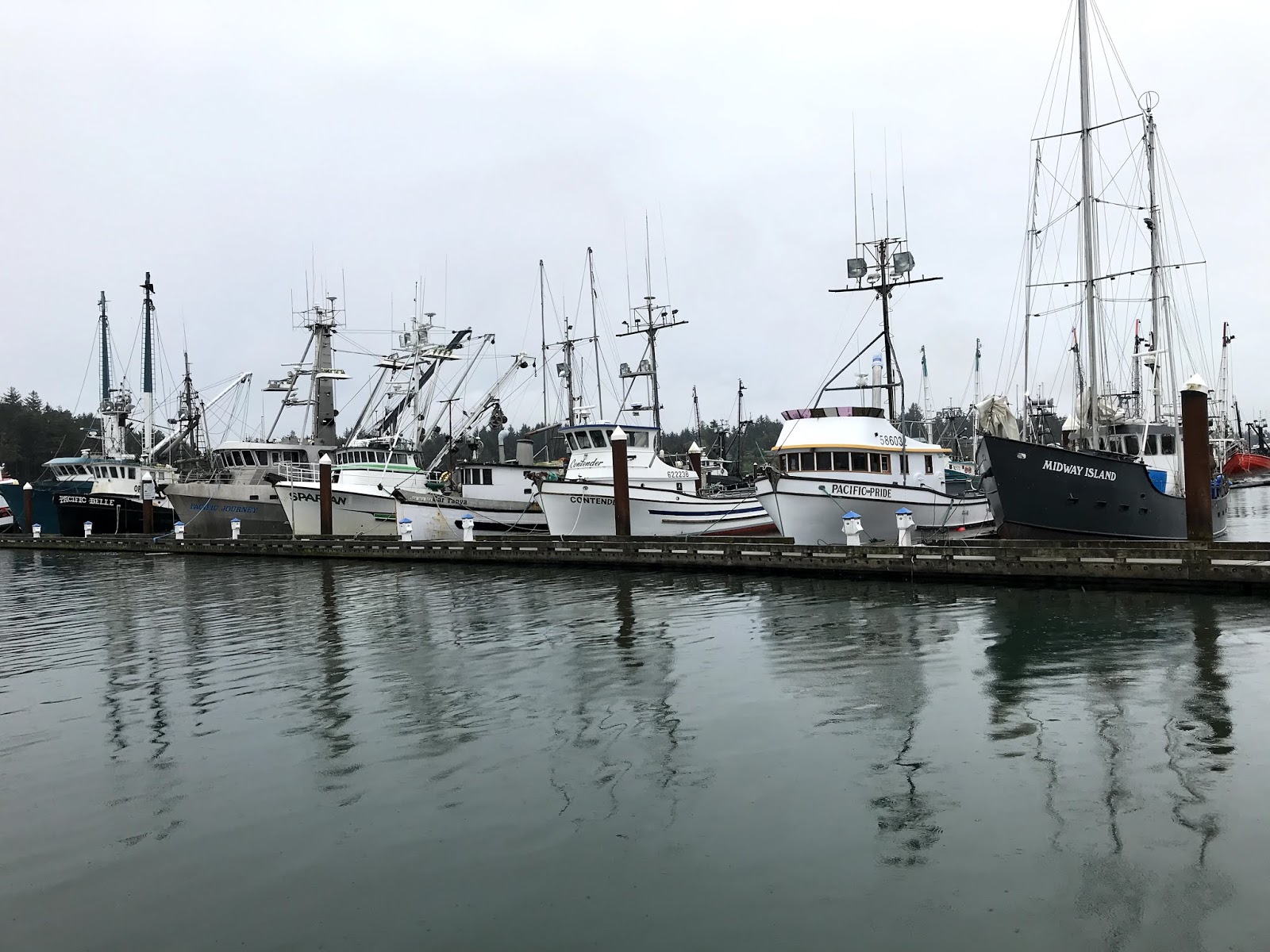
Before departing, Captain Knute welcomed the group and gave some safety instructions.  And we were off!  We passed some of Charleston, Oregon's fishing fleet as we left the harbor.  Charleston is a commercial fishing port, and a fish processing plant is actually right across the street from the OIMB.

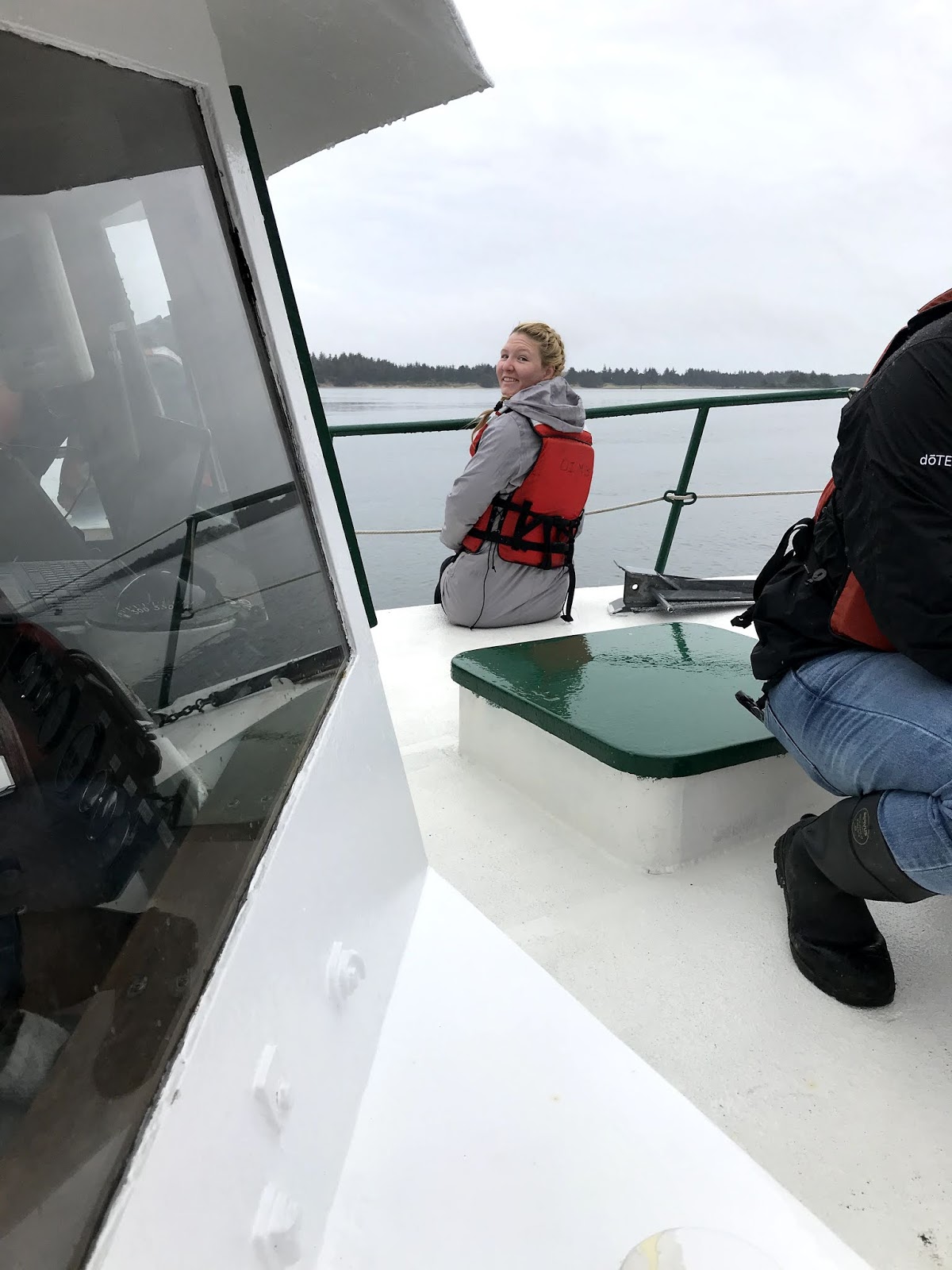
It was a gray, overcast but calm morning as we headed out onto the bay.  The wheelhouse on the boat is fairly small, so most of the time most of the students were out on deck (me too).  We did not need to leave Coos Bay to do what we needed to.  That was nice.  We were on relatively calm water and didn't have much wind either.

Here are (L-R) Ben (turned away, Jenn, Eric (background), and other mystery students hooded up.


Meanwhile on the foredeck, Hunter, Caleb, Matt and Anne took in the sights as we headed out.


As did Chey, who was also up there.

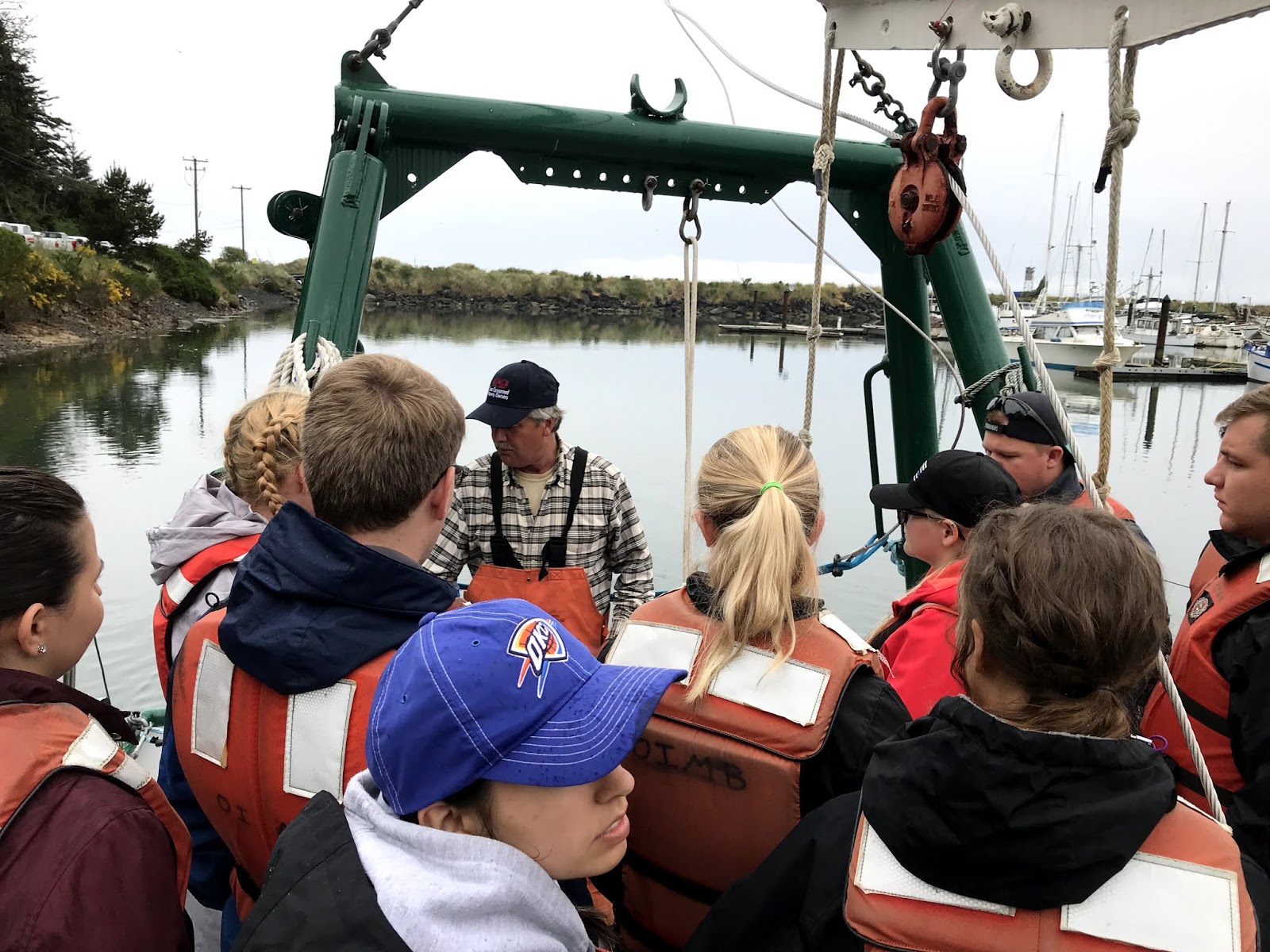
Once underway, Capt Knute had time to chat with our group.  Here he is with Ben.


Our first task was to deploy the plankton net and collect plankton to take back to the lab.  A plankton net, at least the one we used, was perhaps a meter in diameter.  After pulling it behind the boat for a little while we needed to haul it in and put the sample in jars.  We did two plankton tows.  

Michelle is pulling in the plankton net as Victoria looks on.


Shortly after we left shore, it started to sprinkle and then to rain.  Up went the hoods and people started to shelter under the aft overhang of the wheelhouse, but spirits and morale remained high.  Here are (L-R) Collin, Chey, Maddie, Emma and Michelle.


And toward the stern were (L-R) Matt, Jenn (facing away), Eric and Sam.

In this photo should note that the wire cable coming off of the winch is taut. This means that we were in the middle of a bottom trawl using an otter-trawl net.  

And the rain kept on coming down...


When it was time to retrieve the net, someone has to guide the cable back onto the spool so it goes side to side and doesn't wrap up too much in one place.  Liv volunteered to do that job of a deckhand during one of the retrievals.


We attempted two bottom trawls, but, alas, the net was fouled and we didn't get any samples either time.  So, sadly the efforts to bottom trawl were a bust.  By this time many in the group were wet and chilled so we headed back in.  By the time we docked we'd been been out for three hours...just like the crew and passengers of the SS Minnow (Gilligan's Island), except we made it back to shore a-okay!

Here were a couple of nice finds.  This first one is something that I'd know about for a long, long time, but I'd never seen a live one.  This is a planula larva of a cnidarian, possibly a sea anemone.  If successful, it will settle down someplace and metamorphose into a juvenile anemone or some other kind of cnidarian.


If you look carefully in the center of this photograph you'll see something that looks like it has clusters of needles sticking out of it.  It is a larval annelid worm of some kind.  It will eventually elongate and start adding segments.  It will then settle out of the water and become a juvenile worm.  Very cool stuff, right?


By the end of the afternoon we were all pretty well bushed, and ready to rest up for the next day.

This outing was the last of our scheduled marine biology class field experiences.  From now on we will still have daily lectures and the rest of each day will be devoted to student research.

Wednesday, May 15, 2019

MBFE - Thursday 5/9 - MUD! And research proposals.

If this is Thursday, then it must be time to go play in the mud!

And that's just what we did.  Shortly after breakfast we booted up and strolled down the street, across the road and down onto the Charleston Harbor mudflat.  Luckily we had a warm, sunny day, though somehow it feels more appropriate to do this fieldwork when it rains. :-)

Here are is the group, divided into three field teams just getting started.  Their task for the day was to collect the data they needed to generate a vertical profile from the water's edge all the way to the high tide line, perhaps 200 meters away.  

To do this, they used the same equipment they used to generate the vertical profile along a rock shore, except that when they did that they collected data ever meter along the transect line.  But, here they collected data every 10 meters.

Walk, measure, dig, identify, move on...


Here are Victoria and Caleb on the poles, Anne taking notes and  Live and Jenn getting ready to play (er collect data) in the mud.


The next team had Sam and Eric on the poles, with Michelle, Ben and Matt getting ready to collect data.


And the last group had Emma and Maddy on the poles, and Hunter, Chey and Collin collecting data.


The students were surprised to find as many cool things as they did living in the mud, including worms, clams and mud shrimp.  Plus, at the water's edge there were many juvenile Dungeness crabs and some small flatfish as well.  Neat!


It took nearly three hours, but, THEY DID IT!  It really was a great day, and an experience the students will not soon forget.


Then, in the afternoon we spent another hour and a half discussing a case study of restoration ecology in the nearby South Slough National Estuary Research Reserve in preparation for our planned visit there the next day.

Thursday evening I met with each research team and we discussed the the feasibility of their plans.  Here's what they came up with:

Team 1: Jenn and Hunter - They propose to study the adhesive strength of high intertidal limpets on rocky shores as a strategy for avoiding being swept away by heavy wave action.

Team 2: Liv, Sam and Victoria - they originally planned to do a project involving the top predator sea star Pisaster, but since those sea stars are still recovering from the recent sea star wasting disease epidemic that hit the entire west coast a few years ago, they switched to doing a research project using juvenile Dungeness crabs to test their substrate preferences.

Team 3: Emma and Maddy - These two are going to do a population demographics study on the black turban snail, Tegula funebralis. They plan to collect data on their size and age between different locations.

Team 4: Michelle and Caleb - This team originally wanted to test adhesive power of the chiton Mopalis muscosa, but since switched to a population demographics study examining individual size by location.

Team 5: Collin and Chey - This team plans to do a variant on a study done in Great Britain testing the effects of a chemical on the feeding response time of the sea anemone Anthopleura elegentassima.  They are still working out the details, but they are leaning toward looking at the effects of sunscreen on these animals.

Team 6: Eric and Matt - This team is going to look at the inter-clonal fighting responses of the sea anemone Anthopleura elegantissima.  Sort of a gladiator wars study.

Team 7: Anne and Ben - This team proposed to do a descriptive developmental biology study examining the timing of development of embryos of the high intertidal limpet Lottia digitalis.  That is, if they can get them to spawn.  We all have our fingers crossed. 

Sunday, May 12, 2019

MBFE Weds 5/8/2019 - Back to South Cove, Cape Arago State Park

Tuesday afternoon we spent a couple of hours discussion strategies intertidal marine organisms have for dealing with water flow forces, as well as desiccation stresses, etc.  And today we had the best low tide so far (-1.0' MLLW) and fantastic weather so we headed to South Cove, Cape Arago State Park, where I cut the group loose to look for examples of the strategies we discussed the previous day. 

It was still cloudy when we arrived around 8am, but within an hour the fog and clouds burned off and we had an absolutely lovely, sunny, warm and calm day.  Students were not assigned to research teams, but they are always expected to use the buddy system while at the shore - just for safety.

Here Hunter, Collin, Chey and Liv head out toward the rocky shore.


It didn't take long for Victoria to make a lucky find, though the crab got her back with a nasty pinch to the thumb.  Victoria handled it with grace and a smile.  And, of course, other class members wanted to meet this crab as well...


Chey...


Liv...


Collin...


It's always fun to me to watch the MBFE students develop friendships and meld into a working team during the field experience.  Some friendships that start here can last a lifetime.

Here are Hunter, Michelle, Maddy and Jen clowning around with a bull kelp.


Anne, Caleb and Sam explore the lower intertidal zone.


And here Collin, Jen, Victoria, Maddy and Emma share a discovery.


After spending a couple of productive hours at South Cove, we decide to strike out on an adventure and work our way around the point between South Cove and Middle Cove.  

This requires not a small amount of scrambling over rocks and pools.  It was fun though.


We made it to Middle Cove.  Interestingly, South Cove is a protected rocky shore, while Middle Cove is an exposed rocky shore, and so has different things to offer.


These are the kinds of experiences that the MBFE students remember for the rest of their lives.

Normally, we have lecture in the afternoon after a morning like this, but the weather was simply fantastic, so I released the students to enjoy the sunny, warm weather on the Oregon coast (a relatively rare thing).  I later learned I would have had to cancel class anyway because there was a scheduled power outage at the lab that I knew nothing about.  Serendipity!

Not to worry, I have a full day planned for tomorrow.

Monday, May 6, 2019

MBFE - A new week, and back into the field for the MBFE crew

Over the weekend the low tides during daylight hours shifted from the late afternoon to the early morning, so today the students wore their field gear to breakfast and we were on our way to the shore at 7:30am.  Today's exercise?  Plot the profile of a rocky shore, and collect information needed to see how dominant species shifts as you move from the water line to the top of the intertidal zone.

And here they go!


Here's one five-person research team: Sam and Collin (working the quadrat), Liv and Victoria (working the poles and level) and Michelle (scribe), just getting started. 


Meanwhile, the other groups are also underway.  This team features Anne and Matt on the poles, Eric and Hunter collecting data using the quadrat, and Chey as team scribe.


And team three: Jen and Emma on the poles, Caleb and Maddy on the quadrat, and Ben as scribe.  Let's see...which team member saw the camera come out?  Oh, yeah...you know it's Maddy!  :-)


The morning of field data collection comes full circle as the research team of Collin, Sam, Victoria, Liv and Michelle do their last few measurements, with a playlist of Disney movie songs going in the background and them singing in the foreground!  They know how to whistle while they work.


Some groups finished faster than others, but this doesn't mean they are bee-lining it back to the lab...they take advantage of the low tide at a new place to check things out.

Eric cruises the waterline looking for interesting finds... 


...while Matt looks at marine critters, wondering if there are bacteria in there...


And Emma, Matt, Anne and Ben discover their first sponges and are amazed at the number of sea anemones and seastars around the pier's pilings.


At the same time, Maddy and Jen find that the entire surface is covered with marine life.


After about 2.5 hours in the field, the data are collected and we head back to the lab where each group gathers, shares data and works on developing a graph showing vertical zonation of intertidal organisms along their transect lines, followed by a little down time.

In the afternoon we spent another 2.5 hours in lecture discussing rocky intertidal shores, and the challenges and opportunities of living there.

By the way, did I mention that we had a FLOOD in our lab last night?  One of the water flow tubes bringing water into our class' seawater tank flipped over the edge and proceeded to pour water all over the floor, and I mean all over almost the entire floor!!  Luckily it's not the marine station's first rodeo and they were able to bring in industrial strength shop vacs and had the lab slicked up and largely dried out by the time we got back from the field this morning.

And that's another day in the books for MBFE...don't worry, we are headed back into the field in the morning.


Thursday, April 25, 2019

It's almost time for MBFE 2019

It's t-minus six days until Day 1 of the 2019 BYU-Idaho Marine Biology Field Experience (MBFE).

Every two years, during the first half of the Spring Semester, the Biology Department at BYU-Idaho  offers a hands-on field experience in marine biology and marine ecology.  During the MBFE, BYU-Idaho students live and work at the University of Oregon's marine biological station on Coos Bay, southern Oregon coast.

There are 15 participants this year, and you will get to know them once the experience begins.

As usual, my experience starts before the students'.  I have spent the past few days rounding up gear, packing equipment, books and other things we'll need during the field experience.  All there is to do now is load up and head for the coast where I will meet the students when they arrive at the marine lab on May 1st.

Before things get started, let me give you an idea of what students do while they are part of the MBFE.

The schedule is busy and is built around the tides.  When the tides are low, we go into the field.  So, here's a typical day when there is a low tide in the afternoon:

7:00-7:30 am - breakfast in the marine lab dining hall
9:00 am - 2-3 hour lecture on a marine community, e.g., the muddy intertidal community
12:00-12:30 pm - lunch in the dining hall
1:00 pm - two or three hours in the field exploring a nearby muddy intertidal community, collecting data and specimens to bring back to seawater aquaria in our lab/classroom.
5:30-6:00 pm - dinner in the dining hall
After dinner - students  spend time in the classroom/lab identifying specimens collected earlier that day and talking about possible ideas for research projects

Students certainly get their money's worth during the MBFE since they are often busy and engaged from before 7am often until 10pm.  They study in the classroom, the lab and in the field just about every day until we have visited every major intertidal community we have ready access to: exposed and protected rocky intertidal communities, sandy shores, muddy beaches, an estuary with salt and freshwater marshes, and piers and floating docks.  We also go out on a research vessel to collect organisms from shallow subtidal communities as well as plankton that we study later in the lab.

Stay tuned for updates on these activities as they happen, as well as student research projects that will be conducted starting roughly a week after we arrive.

I look forward to sharing our experiences with you.  Before long you may wish you could be here too.  The southern Oregon coast truly is a wonderfully diverse place, and once you've visited it you'll never forget it.

I'll be back with new postings in about a week.  Cheers!!

Tuesday, May 16, 2017

MBFE - Day 21 - Out to sea

Days 19 and 20 were a Saturday and a Sunday, largely free time for members of the MBFE.  They did research that needed to be done and then enjoyed some down time.  We attended the Coos Bay Ward again and had a fun Home Evening.  Bri gave the thought.

Day 21 was full, full, full!

The morning of Day 21 each research team was back at it full steam.  Some members were working in the field, others in the lab.  I took time to touch base/check up on each group to make sure they were doing all right.

Just before lunch I crossed paths with "Captain Mike". OIMB's chief boat captain.  He told me that he could take our group out on the boat to do some bottom and plankton tows.  The weather was great. It was windy but sunny!  The MBFE crew's spirits were high as we boarded the RV (Research Vessel) Pluteus.  Pluteus is the name of sea urchin larvae.

Here's the group before we left the dock.


Here's the whole crew (L-R) Dr. H, Stephen, Wyatt, Katie (front), Janae (behind), Harrison, Courtney, Rob, Darby, Emily, Bri, Jay, Darren, Caitlin, Ashley.

Fifteen passengers set sail that day for a three hour tour, a three hour tour...(sound familiar?)

We had a great outing.  It was fun being on the water and the class really enjoyed seeing this aspect of marine biology.  We did a couple of bottom dredges and a couple of plankton tows.  

Here are a few shots of the crew while we were out.

Students were able to all the deck work while we were out.  In this shot Wyatt is running the winch and Courtney was monitoring the dredge during the tow.  (L-R) Rob, Bri, Wyatt, Courtney, Darren,  

(L-R) Bri, Wyatt, Courtney (foreground), Darren, Ashley, Caitlin and Stephen.


Another shot of the working deck (L-R) Katie, Rob, Darby, Janae, Emily, Bri, Wyatt.

You aren't surprised when a bottom tow produces a haul of sand dollars, but this time it offered up other sea change...looks like a sand quarter, a couple of sand nickels and a sand dime (Emily).

Harrison (foreground) monitors the dredge during another bottom tow.  Others are (L-R) Katie, Emily, Janae, Darren, Wyatt, Rob, Captain Mike, and Ashley. 

Also on deck are (L-R) Rob, Captain Mike, Ashley, Courtney, Stephen (back) and Bri (front).

It was fun to see what was in the bottom drags.  It's like Forrest Gump's mother says, "Life's like a box of chocolates, you never know what you are going to get." (L-R) Stephen, Ashley, Caitlin (fore), Courtney (back), Harrison (on the cable), Jay, Katie, Emily, Rob.

Stephen and Emily look at a sample from the plankton tow.  

Though we'd already had a busy day we pulled out the microscopes as soon as we got back to the lab to see what we could see.  It was a fantastic sample!

This shot highlights a couple of arrow worms - sharks of the plankton.

This was a real score.  I hadn't seen one of these in real life before - it's an Appendicularian.  It's a tiny tadpole shaped animal that's actually a distant relative of ours, it's an invertebrate Chordate.  It usually lives in a mucous house that it secretes, but it bails out when disturbed.  A plankton tow definitely counts as a disturbance!

This is a larval fish.  Larval fishes are TINY!

This was a great, though tiring day.  Missions accomplished!  The students (and I) loved it.