Showing posts with label Biology. Show all posts

Tuesday, May 16, 2017

MBFE - Day 21 - Out to sea

Days 19 and 20 were a Saturday and a Sunday, largely free time for members of the MBFE.  They did research that needed to be done and then enjoyed some down time.  We attended the Coos Bay Ward again and had a fun Home Evening.  Bri gave the thought.

Day 21 was full, full, full!

The morning of Day 21 each research team was back at it full steam.  Some members were working in the field, others in the lab.  I took time to touch base/check up on each group to make sure they were doing all right.

Just before lunch I crossed paths with "Captain Mike". OIMB's chief boat captain.  He told me that he could take our group out on the boat to do some bottom and plankton tows.  The weather was great. It was windy but sunny!  The MBFE crew's spirits were high as we boarded the RV (Research Vessel) Pluteus.  Pluteus is the name of sea urchin larvae.

Here's the group before we left the dock.


Here's the whole crew (L-R) Dr. H, Stephen, Wyatt, Katie (front), Janae (behind), Harrison, Courtney, Rob, Darby, Emily, Bri, Jay, Darren, Caitlin, Ashley.

Fifteen passengers set sail that day for a three hour tour, a three hour tour...(sound familiar?)

We had a great outing.  It was fun being on the water and the class really enjoyed seeing this aspect of marine biology.  We did a couple of bottom dredges and a couple of plankton tows.  

Here are a few shots of the crew while we were out.

Students were able to all the deck work while we were out.  In this shot Wyatt is running the winch and Courtney was monitoring the dredge during the tow.  (L-R) Rob, Bri, Wyatt, Courtney, Darren,  

(L-R) Bri, Wyatt, Courtney (foreground), Darren, Ashley, Caitlin and Stephen.


Another shot of the working deck (L-R) Katie, Rob, Darby, Janae, Emily, Bri, Wyatt.

You aren't surprised when a bottom tow produces a haul of sand dollars, but this time it offered up other sea change...looks like a sand quarter, a couple of sand nickels and a sand dime (Emily).

Harrison (foreground) monitors the dredge during another bottom tow.  Others are (L-R) Katie, Emily, Janae, Darren, Wyatt, Rob, Captain Mike, and Ashley. 

Also on deck are (L-R) Rob, Captain Mike, Ashley, Courtney, Stephen (back) and Bri (front).

It was fun to see what was in the bottom drags.  It's like Forrest Gump's mother says, "Life's like a box of chocolates, you never know what you are going to get." (L-R) Stephen, Ashley, Caitlin (fore), Courtney (back), Harrison (on the cable), Jay, Katie, Emily, Rob.

Stephen and Emily look at a sample from the plankton tow.  

Though we'd already had a busy day we pulled out the microscopes as soon as we got back to the lab to see what we could see.  It was a fantastic sample!

This shot highlights a couple of arrow worms - sharks of the plankton.

This was a real score.  I hadn't seen one of these in real life before - it's an Appendicularian.  It's a tiny tadpole shaped animal that's actually a distant relative of ours, it's an invertebrate Chordate.  It usually lives in a mucous house that it secretes, but it bails out when disturbed.  A plankton tow definitely counts as a disturbance!

This is a larval fish.  Larval fishes are TINY!

This was a great, though tiring day.  Missions accomplished!  The students (and I) loved it.

MBFE - Days 17-18 - More on MBFE research teams and experiences

I guess the main thing to report is that research projects are underway and ongoing.

Here are the research groups in action:

(L-R) Katie, Emily, and Courtney

This team spent the morning collecting more sea anemones from the base of the OIMB pier. They are studying the effects of varying intensity of light on on bleaching in sea anemones.  While out there they found some interesting things...first was a 7-armed Pisaster ochraceus (purple seastar, see below).  The entire class is learning from first-hand experience that there is a lot more natural variability out there than they originally thought.  For example, though these sea stars usually have 5 arms during the MBFE we've spotted individuals with anywhere from 4 to 7 arms.  Life rocks.


They also found juveniles of the same species.  This is a good sign.  Populations of this species along with several other west coast species of seastars were hammered by a virus back in 2013 causing populations of many species to crash.  It's good to see at least some species showing strong signs of recovery.  We still hold out hope for others that have not yet done so.


The next team is Rob and Harrison.  They are asking the question "Is there a difference in competitive ability between different clones of green anemones?"  To answer their question they are are carrying out pair-wise battles between members of different clones.  The results?  Stay tuned. Data are still being collected.


Darby, Wyatt and Janae chose this location as one of their field sites.  They are collecting data showing how often the black turban snail is attacked by crabs and survives.  


Here are members of this team (L-R) Janae, Darby and Wyatt.

The next team is Caitlin, Ashley and Bri.  The photo below shows the location of one of their studies. They are working on a digital field guide to the rocky area at the south end of the beach between Yoakam Point to the north and Gregory Point to the south.  Locals call this Lighthouse Beach (for good reason).   It's kind of a locals only beach...others would not know easily to access it.  


Yeah, it's kind of a dump as far as scenery goes, don't you think?  Just kidding.  The southern Oregon coast is absolutely dripping with scenic ocean vistas.


This team is (L-R) Ashley, Caitlin and Bri.

The next team is studying the effects of varying seawater acidity on the development of sea urchin embryos.  Embryonic and juvenile forms of marine invertebrates are often the life stages that are most susceptible to variations in physical conditions such as pressure, salinity and pH.


This team is (L-R) Darren, Jay and Stephen.

Each team is discovering interesting things about nature, the nature of research and themselves as they progress through this experience.  Like Jim Carrey as the Grinch says, "But that's what these tests are for!"  

Stay tuned for more updates!

Thursday, May 11, 2017

MBFE - Days 15-16 - And class and research go on

We have worked into a class and research routine over the past few days of the 2017 MBFE.  We are entering another series of low tides, this time in the morning.  The tides have been early, around 6-7am the past few days so students have been getting up and out to do field work and collect organisms as needed for their projects.

In the afternoons we have 2-3 hours of class.  Just in case you're wondering what we've been covering in class...on Day 15 we discussed non-fish marine vertebrates.  Those include marine mammals (whales, dolphins, seals, sea lions, and manatees), marine reptiles (turtles and snakes) and a little about marine birds.  Then on Day 16 we took a look at life in the deep sea pelagic zone.  That's the part of the ocean below the surface layer where photosynthesis can take place and the bottom, but not including the bottom.

The evening of Day 15 we had a weekly class meeting where we talk about scientific writing and research.  During that meeting I emphasized the importance of staying on top of research projects and spending significant amounts of time in the library doing background research in order to become expert on both the research topic they are asking and the organisms they are working with.  I really worked to make a point with them about how important library research is and I think I may have freaked them out a bit.  Well, we got that cleared up so the students understand that each day needs to include class, research and time in the library or writing.  Mission accomplished.

The evening of Day 16 we traveled into Coos Bay to attend a meeting of the local Audubon Society to hear Larry Basch (a friend of mine from graduate school days) talk about his time in the Galapagos Islands.


Here's info from their advertisement:

Cape Arago Audubon Society, Coos County, Oregon
Our mission is to promote appreciation and understanding of the birds and natural environment of Coos County through education, field trips, and local restoration and conservation projects that enhance our community.

CAAS Chapter Meeting - Wednesday May 10, 2017 7 pm

"A Biologist's Dream: Wet and Wild Life of the Galapagos Islands" will be presented by CAAS member Dr. Larry Basch on May 10 at 7 PM at the Coos Bay library. From the air above, across this renowned archipelago, and under nearshore coastal waters, come and see island endemic birds, other animals and plants unlike ones you've ever seen! Open and free to the public.

He did a great job covering a rich topic and making it accessible to scientists and non-scientists alike.

The MBFE is going well and students are making good progress on their research and from all accounts are thoroughly enjoying the experience.

Stay tuned for future updates.

Wednesday, May 3, 2017

MBFE - Day 8 - South Slough - National Research Estuary

Here we are, day eight of the 2017 marine biology field experience for BYU-Idaho students.

Tides have now switched to the low tides being in the afternoon, so we spent time in the classroom this morning...we managed to cover salt marsh communities as well as docks, piers and pilings.  The class is doing great!

After class we took a class field trip to the South Slough National Estuarine Research Reserve, or SSNERR for short.  It is one of only about half a dozen such national research estuaries that have been designated along the entire west coast, and this one is only about 5 miles from here as the crow flies.

Some of the class visited this place on Sunday but they were happy to go back.  It's a beautiful place and entirely unlike pretty much anywhere in Idaho for sure.  To get to the slough we took a trail down along a stream through Oregon's coastal uplands and this is the sort of scenery we had.

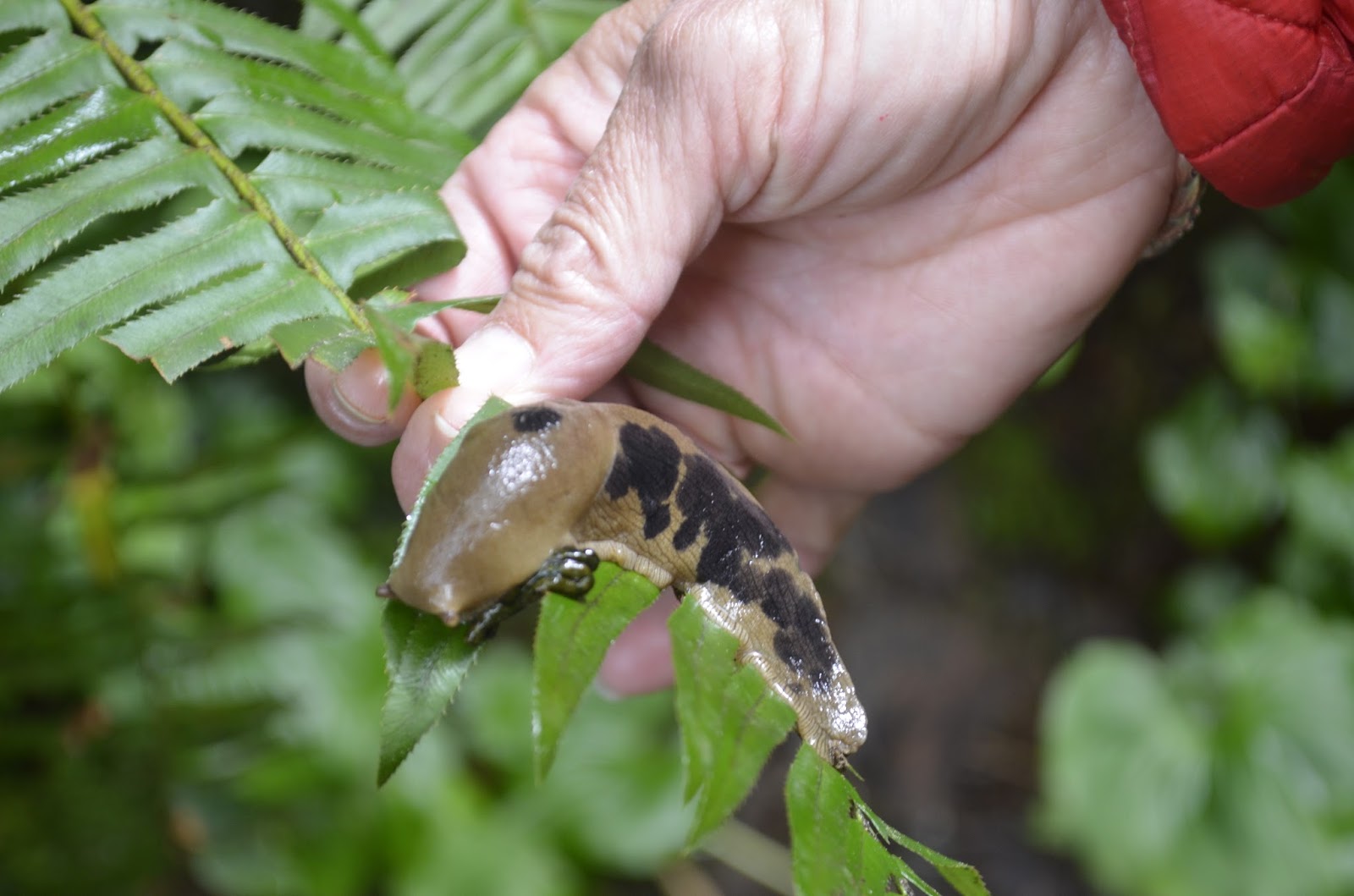
With this kind of vegetation, you half expected a dinosaur to come crashing through the underbrush. Instead we had to content with forest denizens like these!

Oregon's version of a banana slug.

Courtney likes them!  Besides, what's not to like?!

And this terrestrial snail - beautiful!

We eventually made our way down to overlooks were we could see the estuary.  When we arrived the water was low so lots of mudflats were exposed.  During high tide all of these muddy areas are covered by seawater that pushes upstream.

Here's the crew at the first overlook.  
(L-R) Stephen, Ashley (back), Darby (front), Janae, Emily, and Jay (others in the background)

This is what the estuary looks like at high tide.  Beautiful tidal marshes!

What does the class think about that?  Just ask Darby and Janae!


Later on we spotted a cool visitor to the estuary - Great Blue Heron!  Nice!  We watched it snapping small fishes out of the water.  Now that's nature!


We wrapped up our Tuesday with a class meeting where we discussed formatting for research manuscripts and doing an exercise that introduces the principles of research design.

And the trip goes on.  Stay tuned for more!


Saturday, April 29, 2017

MBFE Day 5 - More sun and more rocky shores - Sunset Bay

It's Day 5 of the 2017 BYU-I MBFE, aside from a little fog the morning dawned clear and bright. This was our sunrise over the Charleston Harbor boat basin about 30 mins before the breakfast bell rang.

Yeah, I know, it's not very picturesque here but we are struggling by. :-)

The low tide happens about half an hour to an hour later every day so by now the low tide, another great one of -1.6', happened late enough in the morning that we had a more leisurely breakfast before heading off to Sunset Bay and doing more field work.

The plan for today's field work is to give students a chance to learn how to collect data needed to generate a species diversity index.  The group divided into five teams.

Janae, Darby and Wyatt have identified their study site and are ready to start collecting data.

Harrison and Rob are hard at work counting lots and lots of barnacles, among other things.

Emily acts as data recorder as Jay and Courtney survey their site.

Bri, Caitlin and Ashley work their site as well.

After data collection is done the MBFE crew spread out and explored another new place, the rocky intertidal zone around the southern edge of Sunset Bay State Park.

Teams are wrapping up their work (Wyatt, Darby and Janae in the foreground, and Katie, Stephen and Darren in the background.  Dr. H's wife also came along to check out what the group had going. 

Harrison and Rob explore and discuss research possibilities. 

Here Ashley and Caitlin look over the rocky shore with the Cape Arago lighthouse in the background.

One new species the group found was the sea palm, Postelsia palmaeformis, one of the cutest seaweeds along the west coast.

Emily shows off a find - an intertidal crab.

Did you know that a length of the hollow stipe of the kelp Nereocystis can be played like a bugle?  Class members give it a try.  It's fun, though the mucus from the seaweed can dry out your lips.  Emily gives it a try.

Courtney tried but was too busy laughing most of the time to get much out of it.  "I'm a violinist," she explained.

Darby tried too, not getting more than a wheeze out of it at first, but redeeming herself later with a good blow.

Wyatt gave it a shot...

As did Janae and other class members.  

Marine biology is fun...and btw, I'll bet you didn't know that people also sometimes make pickles out of this species of kelp.

Once the morning's work was done and we returned to the lab the students were released, and are off the clock until Monday.  Everyone needs some down time!

More to come...stay tuned.


MBFE - Day 4 - Rocky shores and sunny skies

Though we'd only been on site for a few days, we were relieved and excited to see the sun.

The OIMB Dining Hall staff were great.  They had sack breakfasts ready for us by 7am so we could be in our way to the rocky shore at Cape Arago's South Cove and a -1.6' low tide.  Man oh man it was a great morning!  The rain and cold wind of the previous days set us up nicely for a morning doing field work in the rocky intertidal zone at South Cove, Cape Arago State Park.

Here's the 2017 MBFE crew at about 7:20 am getting ready to head down to the shore:

MBFE 2017 (L-R)
Dr. Holyoak, Courtney, Harrison, Bri, Wyatt, Ashley, Jay, Katie, Rob, Darby, Stephen, Janae, Darren, Emily and Caitlin
The crew divided into three teams again, and each team carried out a species richness survey of a tide pool and adjacent non-tide pool rocky area in the mid-intertidal zone and again higher in the intertidal zone.  The groups all went to work with a will.

The group works its into the rocky intertidal zone at South Cove.

After some final instructions the groups are off to work their field sites.

Here are (L-R) Wyatt, Darby, Rob and Jay working one of their sites.

Here are Harrison, Emily, Janae and Darren doing their species count.

(L-R) Ashley, Katie, Caitlin, Bri and Courtney collect data. 

After data collection was done, MBFE team members were encouraged to spend time exploring this rich intertidal zone, collecting specimens they did not yet know and thinking about research.  Some of them surprised themselves by not only what they saw, but by what they were willing to pick up and hold - yep, this is the stuff marine biologists are made of!
Here's Dr. H in his native habitat with a lovely specimen of the brown alga Alaria marginata

MBFE team members clamber over rocks looking for new friends and undiscovered treasures.
(L-R) Rob, Caitlin, Ashley, Jay, Dr. H,, Bri and Katie

Rob and Dr. H put their faces where their feet are to get a better look at all things intertidal.

(L-R) Darby, Janae, Dr. H, and Jay show off their finds.

Here a sea slug in a tide pool.

Students found the largest species of chiton in the world (a chiton is a mollusk that is related to snails and slugs)

Here are some orange sponges living under the edge of a rock.

Courtney poses with a new friend - Cryptochiton stelleri

And Caitlin does the same, "Just to prove to everyone at home that I can do this,"  Anyone surprised?  I guess even she was.

Students also saw sea urchin hotels where many urchins had worm away soft rocks to make homes for themselves where they'd be protected from waves and predators.

When the work was done some members of our group found a dry rock and soaked up the sun.  What a great place to go to work!

Before we knew it we'd been at South Cove for about three hours.  What a great day!  And just when we thought it couldn't get any better, Wyatt thrilled the crowd with his find...the remains of a giant pacific octopus. It had apparently washed ashore and was then dragged above the intertidal zone by some kind of scavenging animal, maybe a dog or possibly a raccoon.  

There's no scale, but the part of the octopus that was left was probably around two feet across.  The arms and suckers were amazingly muscle-bound.  Don't worry, Wyatt's quest for a live octopus continues.

After a busy, busy week of early mornings, long hours in the field, the classroom and the lab stretching into the night, how did the group feel when they were done? 

 TRIUMPHANT!
(L-R) Rob, Darby, Janae, Dr. H, Wyatt, Ashley, Emily, Bri, Jay, Katie, Darren, Caitlin, Courtney, Stephen and Harrison

AND POWERFUL!  

Stay tuned for the ongoing adventures of the 2017 BYU-I MBFE.