Showing posts with label sunset. Show all posts

Thursday, April 27, 2017

MBFE - Day 3 - Fun in the mud

The tides continue to come early in the morning, and this morning, right after breakfast the crew pulled on those rubber boots and after a change of plans, headed off to our friendly neighborhood mudflat.  It's fantastic to be someplace where we can go on a 5-minute walk and be in an amazing marine habitat - today, MUD!

Did you ever get in trouble as a kid for playing in the mud and getting filthy?  Today that class was assigned to dig in the mud, muck around and see what they could find.  They were genuinely surprised to find as much as they did living in the mud - clams and worms and ghost shrimp, Oh My!

Here is the group divided into three teams surveying the diversity of life living in the mudflat from the low tide line up to the top of the mud, a distance of over 150 meters.

Here are (L-R) Emily, Bri, Ashley, Janae and Wyatt getting ready to survey their second site.

This group made up of (L-R) Caitlin, Harrison, Darby, Jay and Stephen take an elevation change reading between two sites.

Once the elevation difference was noted it was time to dig and see what comes up.

In this team (L-R) Emily, Wyatt, Bri, Ashley and Janae, some team members couldn't wait to get in there and get their hands dirty.  

Here is another team (L-R) Courtney, Rob, Katie and Darren digging into another sample site.

Everyone was grateful for a non-rainy morning.  The wind was brisk and the sky was cloudy but it wasn't drippy.  

It was fun to watch the groups as they moved toward the uppermost sample sites in the mudflat...I knew what they were likely to find, and they did...GHOST SHRIMP.  These are burrowing shrimp that can be up to about 5-6 cm long, a surprising find since all the teams had seen so far were mainly clams and worms.  

We had a largely enjoyable and fun 3 hours of digging in the mud!

The rest of the day was devoted to a class meeting, recording field data and identifying species found during the outing.  Mission accomplished!

The sky actually cleared this afternoon and we saw the big round yellow thing in the sky - it's been a stranger since we arrived.  The skies stayed clear enough long enough to give us a fantastic Oregon Coast sunset.  This shot was taken at Sunset Bay.  Here's to many more clear days and beautiful sunsets to come.


Tomorrow's plan is to hit the road early and spend the morning at the rocky intertidal zone at Cape Arago State Park.  We can't wait!

Stay tuned!

Saturday, May 25, 2013

Days 19 and 20 - Here's the latest

We did not have any required class outings on Thursday or Friday 5/23-24, but the show went on.  We spent about 3 hours on Thursday discussing community structure and function in the Bathypelagic (deep water) zone - a world largely of perpetual darkness, and another 3 hours or so the following day discussing the Bathybenthic zone (life on the bottom in the deep sea) - muds, oozes, hydrothermal vents, cold seeps, sea mounts...

The MBFE crew spent the rest of their time working on research-related activities.

But first...a bite of lunch in the OIMB Dining Hall:

Here are (L-R) Mackenzie, Lindsey, Blake, Ty, Patrick, and Dallas enjoying a soup, salad, and make your own sandwich lunch.

And at the next table Blake, Kristin, Bailey, and Jessica eat with a group of University of Oregon students.  This happens all the time, and some of our students have made acquaintances and friends with the OU crew. I even heard that OU students have challenged our bunch to a game of volleyball sometime next week - weather permitting.

With lunch out of the way, MBFE students scatter to work on their projects.  

Dallas and Blake discuss their work on how larval and juvenile crabs react to light, and the data they have already collected.

It's Daniel's shift to collect data on developmental stages of sea slugs.  Two more of the sea slug group, Mackenzie and Elysa, do more background work.  If I ever need either of these two, chances are good that I can find them in the library digging into the scientific literature on sea slug development.  That's how you do science!


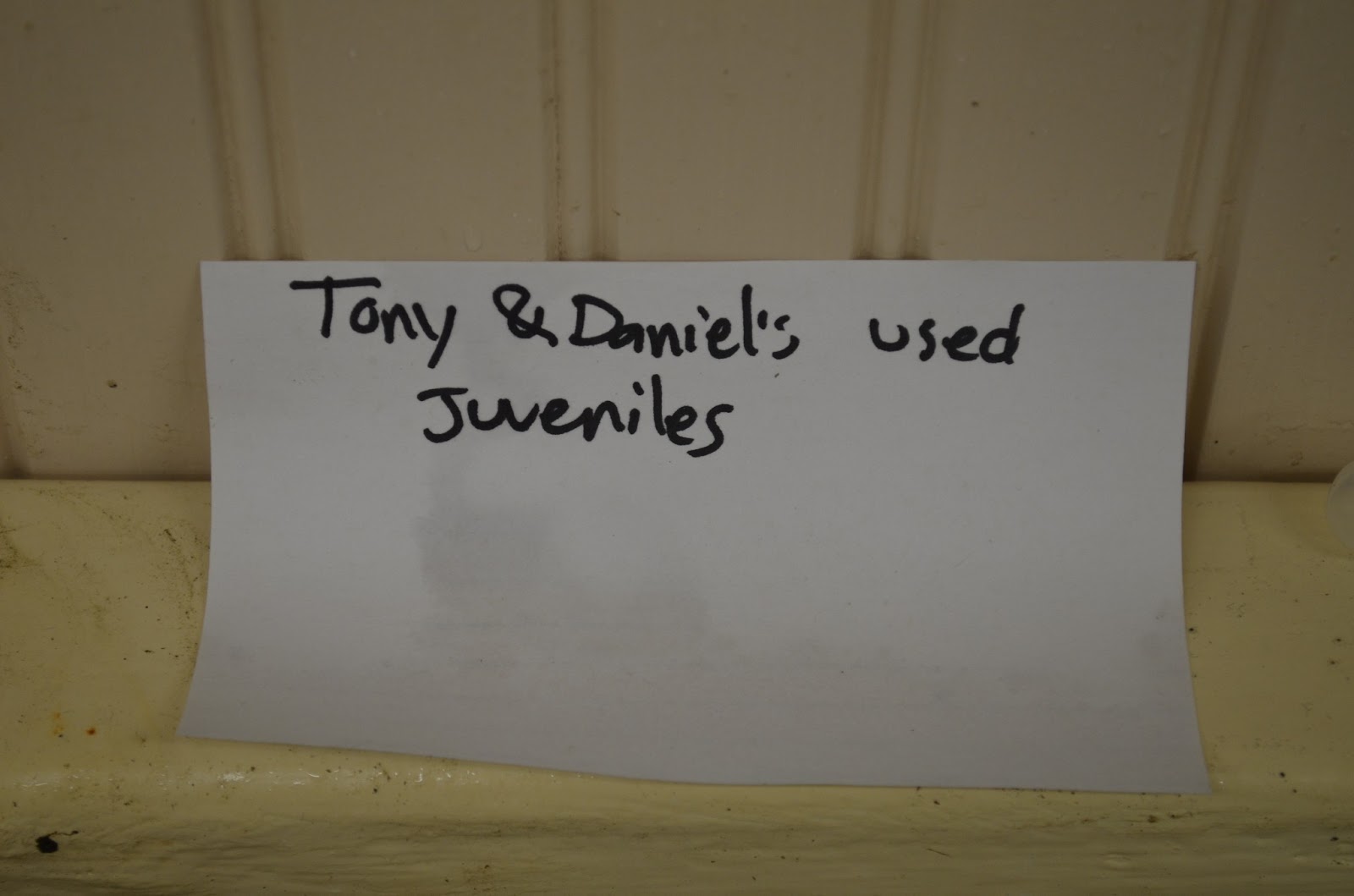
This is an interesting note, left above a bucket in one of the seawater tanks.  It's important to use research specimens only once so that any prior experimental effects won't skew the results.  The used individuals stay in the bucket until the end of the research day, and if Kristin and Lindsey don't need them for their seawater temperature experiments, Tony and Daniel take them back to the harbor where they were collected.


Here are a couple of other fun things from around the lab and nearby locations.  The photo below shows a large number of crabs feeding on a large clam that was given to them for food.  To give you an idea of scale, the crab shell is about 3" long.  The clam was put into the crab holding tank around 11am, and by mid afternoon the crabs had eaten almost the entire thing (except the shell, of course).


When I took a walk along the breakwater last night just before sunset this harbor seal jumped up onto the floating dock in the marina...


 ...and I saw lots of these little sea gooseberries (Ctenophores, comb jellies) being washed ashore by small waves, after which they rolled down the beach toward the water, only to be tossed back up again.


Last night we had a beautiful sunset.  This is a shot from the breakwater looking out to sea.


Stay tuned for more adventures of the first ever BYU-Idaho MBFE.

Saturday, May 18, 2013

Day 14 - Two weeks in, halfway through...and "There be whales here!"

The BYU-Idaho Marine Biology Field Experience (MBFE) hit a landmark today - on 18 May we will be halfway through our time at the Oregon Institute of Marine Biology.

Students spent the morning doing research, followed by class at 11am.  After lunch Patrick and Ty went back to South Cove, Cape Arago, to check on their hermit crab experiments, and then at 3p we had a second session of class.

At 4pm the class attended the weekly OIMB seminar.  This week's seminar was given by a fisheries biologist from NOAA (The National Oceanographic and Atmospheric Administration) based at Humboldt State University, Arcata, CA.  He talked about frontal boundaries between different masses of ocean water and their effects on larval and juvenile rock fishes.  It was pretty interesting.

The main excitement today was when the words "whales sighted" were uttered in the Dining Hall right after dinner.  A U of Ore student told me he'd seen whales just outside of South Cove, Cape Arago, about 30 mins earlier.  You've never seen a group of college students move faster.  Before you knew it, they emerged from one of the buildings toting spotting scopes, binoculars, and cameras.  And we were off to Cape Arago to see what we could see.

We were initially a bit disappointed when we didn't see anything at the Middle Cove observation point, but I spotted whales when we could look into South Cove. The students sprinted over.  Before long everyone was spotting whales blowing.  We counted seven gray whales, including at least two calves.  They are majestic creatures.  We watched them for 45 mins to an hour as they worked their way up the coast.

Gray whale blowing
Cape Arago, Oregon, May 17, 2013
(c) 2013 Alan Holyoak

The students were so excited to see these whales...I mean, who wouldn't be?  It was extremely cool.

I know I took several photos of the group watching the whales, but for some reason not all photos transferred to my computer last night, and I deleted the photos from my camera without double checking - DOH!  You only learn when you lose, I guess.  Sigh...

At least a couple of the sunset shots I took just before we came back to OIMB transferred over.  Here's a particularly nice one over Simpsons Reef, north of Cape Arago, Oregon.

Sunset over Simpsons Reef, Oregon
May 17, 2013
(c) 2013 Alan Holyoak

PS - You will be happy to hear that Dallas' extra car key arrived today, and all is well.