Showing posts with label SSNERR. Show all posts

Wednesday, May 15, 2019

MBFE - Friday 5/10 - Docks, piers and pilings, a trip to the SSNERR, and the OIMB Friday afternoon seminar

We hit the ground running Friday morning.  We started with a lecture/discussion on the pier, dock, and piling communities.  This an extremely interesting community because floating docks often have a mixture of intertidal and subtidal species attached to them.

Following lecture, we had enough time before lunch to go down to the docks and take a look at life there.

So, how does one study a floating dock community, without getting soaked?  Like this...

Let Anne demonstrate.


And here are (L-R) Matt, Eric and Collin taking a close look.


Caleb and Sam won't be outdone.


...nor Caleb!


Here are Emma and Victoria taking a good, long look...


...and Ben too!


Here are are (L-R) Michelle, Jenn, Maddy and Liv hard at work.


And here are just a few examples of what they could see...giant subtidal barnacles...


...sea anemones...


...sponges, mussels other sessile organisms...


...a chiton, mussel, barnacle, and more...


...plus tube worms and more anemones.

Not to worry, our work day wasn't done before lunch.  After lunch we all headed to SSNERR - South Slough National Estuary Research Reserve.  This is one of only five such wetland and estuary research reserves on the west coast of the United States.  So it's awesome that we have such easy access to it!


Here's the crew walking through the lush Oregon coastal forest - it feels downright primeval, like you'd expect to see dinosaurs crashing through the underbrush at any time.

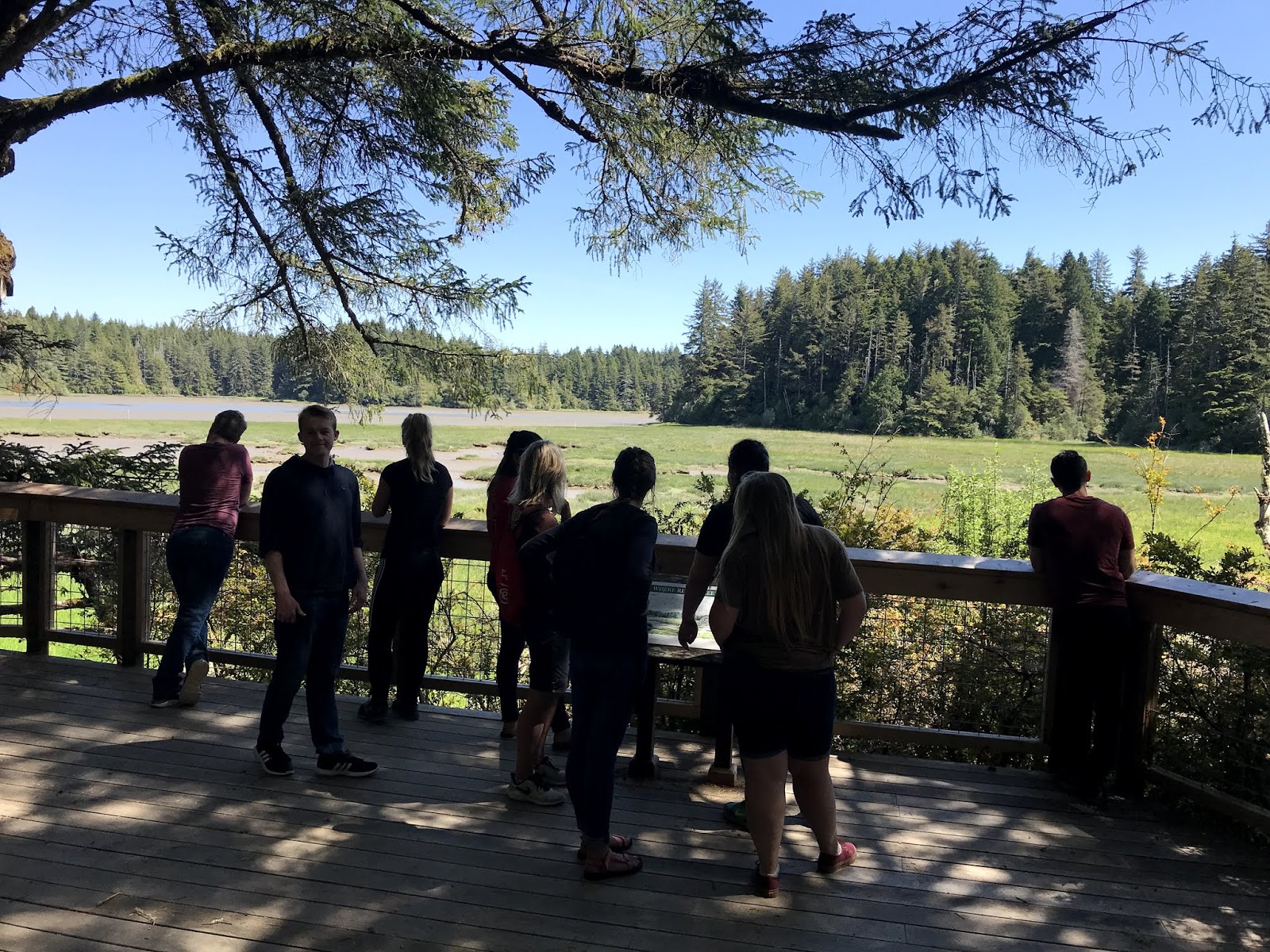
And here's part of the crew looking out over the South Slough mud flat and tidal marsh.  

Here's the crew posing up on a bridge over one of the tidal creek channels. (L-R) Kathrine (Holyoak). Hunter, Sam, Eric, Ben, Anne, Liv, Chey, Collin, Matt, Caleb, Victoria, Maddy, Emma, Jenn and Michelle (top, back).


Somewhere along the way someone picked up a small garter snake, and it took a liking to Caleb, wrapping itself tightly around his thumb.


Here's another shot of the crew making their way along a path at the reserve.  What a beautiful place!


We wrapped up the week by attending the OIMB Friday seminar.  This week the presenter was Heidi Fuchs, Rutgers University, whose talk was titled "Waves and turbulence as navigational signals for dispersing larvae.”  It was an interesting talk about two closely related species of larval snails, one that lived inshore and one that lives offshore, and the different ways they respond to waves and turbulence.

Wednesday, May 3, 2017

MBFE - Day 8 - South Slough - National Research Estuary

Here we are, day eight of the 2017 marine biology field experience for BYU-Idaho students.

Tides have now switched to the low tides being in the afternoon, so we spent time in the classroom this morning...we managed to cover salt marsh communities as well as docks, piers and pilings.  The class is doing great!

After class we took a class field trip to the South Slough National Estuarine Research Reserve, or SSNERR for short.  It is one of only about half a dozen such national research estuaries that have been designated along the entire west coast, and this one is only about 5 miles from here as the crow flies.

Some of the class visited this place on Sunday but they were happy to go back.  It's a beautiful place and entirely unlike pretty much anywhere in Idaho for sure.  To get to the slough we took a trail down along a stream through Oregon's coastal uplands and this is the sort of scenery we had.

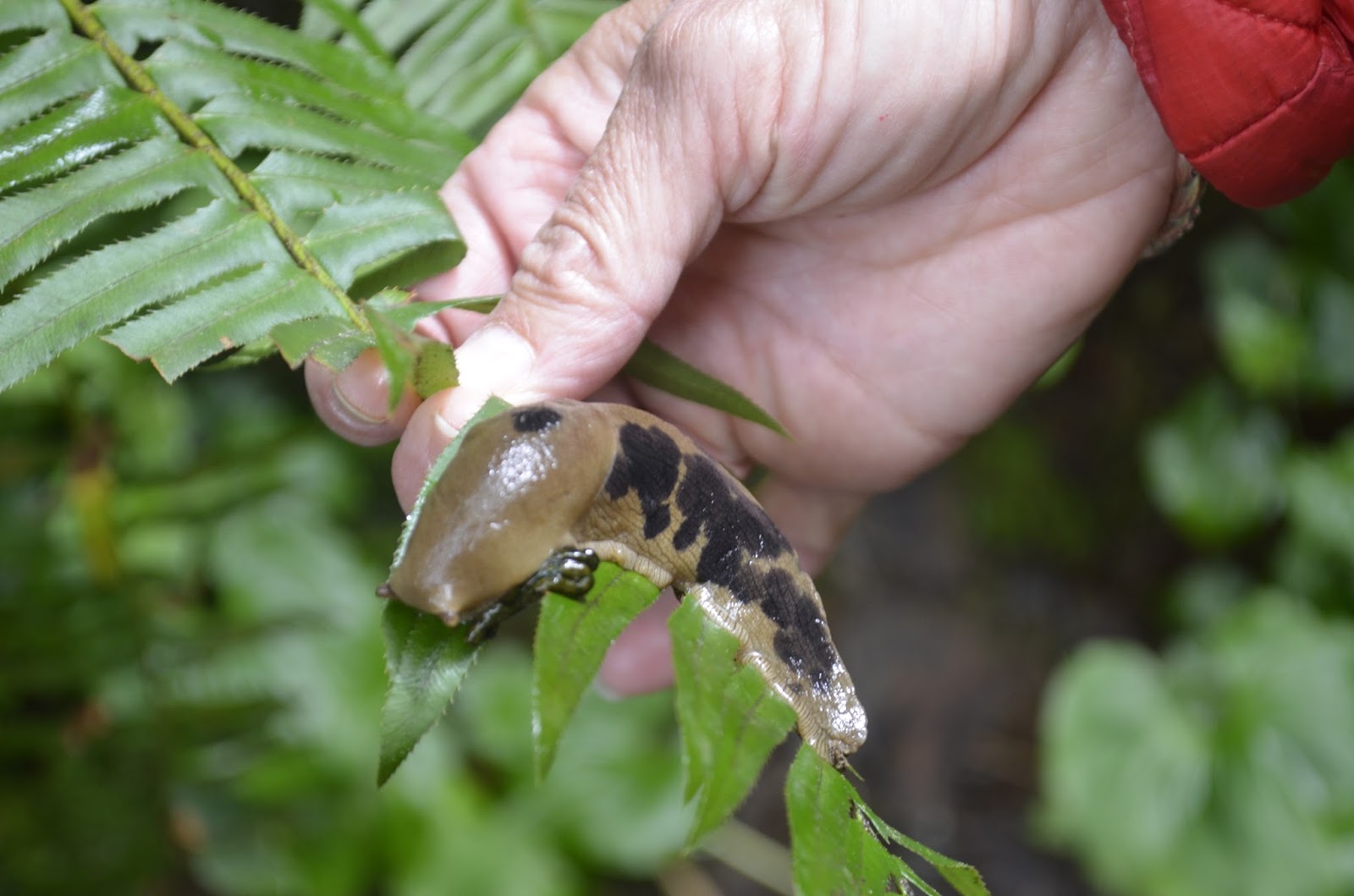
With this kind of vegetation, you half expected a dinosaur to come crashing through the underbrush. Instead we had to content with forest denizens like these!

Oregon's version of a banana slug.

Courtney likes them!  Besides, what's not to like?!

And this terrestrial snail - beautiful!

We eventually made our way down to overlooks were we could see the estuary.  When we arrived the water was low so lots of mudflats were exposed.  During high tide all of these muddy areas are covered by seawater that pushes upstream.

Here's the crew at the first overlook.  
(L-R) Stephen, Ashley (back), Darby (front), Janae, Emily, and Jay (others in the background)

This is what the estuary looks like at high tide.  Beautiful tidal marshes!

What does the class think about that?  Just ask Darby and Janae!


Later on we spotted a cool visitor to the estuary - Great Blue Heron!  Nice!  We watched it snapping small fishes out of the water.  Now that's nature!


We wrapped up our Tuesday with a class meeting where we discussed formatting for research manuscripts and doing an exercise that introduces the principles of research design.

And the trip goes on.  Stay tuned for more!


Thursday, May 7, 2015

MBFE - Day 17 - The Deep Sea

The research groups are pushing ahead with their projects and are excited about collecting their own data and gaining insights into how things work.

In class, we are continuing to work through introductions to the various marine communities. Yesterday we looked at deep sea pelagic communities, while today we studied deep sea benthic environments including deep sea soft bottom communities, hydrothermal vents, and cold methane seep communities.

This was a fun topic since the students know that the Director of OIMB, Dr. Craig Young, whom they have met, specializes in studying deep sea communities.

One of the groups of organisms we covered was the xenophyophores.  These are extremely large single-celled protists that secrete a calcium carbonate skeleton.  These are significant organisms because their presence usually indicates high local biological diversity.  Large specimens usually reach lengths of 20 cm or so.  However, when I was chatting with Dr. Young the other day he showed me a specimen that he collected that is significantly larger than that and may well be the world's largest known specimen of this group.

This is Dr. Young with his prize xenophyophore skeleton.


In other news, Eileen and Rachel M,, the two students on the trip who took marine biology (BIO 314) before the trip, have started a research experience under the direction of the chief scientist at the South Slough National Estuary Research Reserve (SSNERR).  They are doing this in lieu of BIO 314.  They are doing some monitoring work in conjunction with a restoration ecology project that is underway at SSNER.  They are both excited about the possibilities and the experience.


Stay tuned for more updates...


Wednesday, April 29, 2015

MBFE - Day 8 - Estuary - salty and fresh!

Tuesday April 28th dawned gray and rainy...well, drizzly, that's rainy Oregon-style.  That meant that it was a perfect day to discuss salt marsh ecology and restoration ecology at the South Slough National Estuary Research Reserve (which is only about 5 miles form here).  Then after lunch we drove over to the estuary.

It's actually a lucky thing that we didn't visit the estuary on Monday (our beach day) because the interpretive center is open only Tuesday-Friday each week!  Maybe it wasn't luck...anyway we enjoyed roaming around the center for a little while, then we went out for a self-guided hike.

Here's a photo of the crew just before we headed into the primeval forest and down to the estuary (L-R: Courtney, Rachel M, Shannon, Arianne, jennifer, Devon [back], Eileen, Joseph and Rachel S [kneeling], Luke, Danielle, Isaac, Jessica, Kelly, and Skyler).


You can't tell from the photo, but mist was coming down consistently, but still, look at those smiles!

We walked about 1/2 mile down to the overlook to the estuary.  It was actually nice that the mist was coming down.  We saw things we probably would not have seen on a dry day.  We saw salamanders, rough skinned newts, actually.  Devon spotted a snake and was off after it, but no luck.


We also saw birds, and raccoon at two separate locations as they came down onto the mudflats to forage for small invertebrates.


The hike was interesting.  At one point the name of route was "Tunnel Trail".  Here's why:


One of the main reasons we went in addition to seeing the estuary was to take a look at some of the restoration ecology that is being done there as the biologists there try to help the region recover to a more natural condition after nearly 100 years of dredging of the main channel as well as the building of levees and dikes as well as draining tidal wetlands for agriculture.  The restoration efforts started in the 1970s and are ongoing.

Here's a shot of an old levee and you can see where it has been breached to allow tidal water to reenter tidal flats where it went before the dikes were built.


All in all it was another great outing.  Stay tuned for more updates.

Friday, May 31, 2013

Day 27 - Our last full day at OIMB, and my last posting from OIMB for MBFE 2013

The day started fairly early.  Seven of the nine remaining members of the MBFE gathered after breakfast to go to the South Slough National Estuary Research Reserve (SSNERR).  We hopped into my van, I turned the key, the dashboard lights dimmed and I heard that sickening buzz that happens when the battery is dead. Sigh.  I sent them on in other vehicles to the SSNERR to go on an interpretive canoe outing while I stayed here and spent my morning with the good people at the local dealership.

In the meantime Elysa and Mackenzie (who didn't go to SSNERR this morning) rinsed out the MBFE buckets, wiped down the lab table tops, and generally tidied up around the lab.  Thanks!

The SSNERR group reported a fantastic experience upon their return to OIMB.  They said that they gained an increased appreciation for estuaries and wetlands and their ecological roles.  I will try to take advantage of that experience for future MBFE groups.

I was walking back toward my cottage after lunch and noticed hummingbirds zipping around a group of flowering bushes, so I grabbed by camera, wondering if I'd be able to catch any of them on "film"...yeah, I know we don't really use film any more, but you know what I mean.

Rufous Hummingbird (female)
OIMB Campus, Charleston, OR
(c) 2013 Alan Holyoak

This afternoon students worked on tidying things up, worked on manuscripts, and then around 4p a volleyball game broke out. It included BYU-Idaho and U Oregon students.

 L-R: Lindsey, Tony, Daniel, UO student, UO student, Bailey, Jessica, Kristin, Dallas

While the game was going on I slipped into the lab and packed up most of our gear.  It's a happy and sad thing to be saying goodbye to OIMB.


We had one last official class activity.  We attended the OIMB Public Seminar for their semester.  It was given by Dr. Richard Feely, Senior Research Scientist, NOAA (National Oceanographic and Atmospheric Administration).  Dr. Feely is a chemical oceanographer who is recognized as a world authority on the topic of ocean acidification, and is a co-recipient of the 2007 Nobel Peace Prize for his work with the IPCC.  He gave a great talk.

Dr.Richard Feely before the OIMB Friday Public Seminar.

Now all there is to do is load up and head back home.

As I write this last posting from OIMB I want everyone out there to know that each member of the BYU-Idaho MBFE class pulled their weight, worked hard and well, and made this a pleasant experience for everyone in our group and at OIMB.  I talked with Dr. Craig Young, OIMB lab director, this evening and he told me that everybody at the lab from faculty to students and staff had nothing but good things to say about our group.

Tomorrow the rest of the group heads home, except for Lindsey who catches a flight on Sunday.

I want to thank everyone in this first MBFE for your dedication, hard work, willingness to get along and make things work, and for your patience at the somewhat loose schedule that a first offering of an experience like this unavoidably includes.  I look forward to receiving and reviewing each research manuscript, exam, and slide set, and to seeing what you end up doing in your professional lives.

Thanks again!  -- Dr. Holyoak

Saturday, May 18, 2013

Day 13 - BYU-Idaho Marine Biology Field Experience Research

Today started with a short field trip to the Charleston, OR, Boat Basin (marina) where we could see how floating docks work.  The topic for the day?  Marine communities of floating docks, piers, and pilings.  We had class at 9am, followed by time for research for the rest of the day.

We have only one more class "field trip" to do while we are here, and that is to go out on the lab's research vessel and do plankton tows and bottom trawls, but that will probably not happen until next week.

In the meantime student research is shaping up nicely.  Here's a quick introduction to the projects that are currently underway:

1) Elysa, Mackenzie, Daniel, and Tony - What is the timing and developmental pattern for 3-4 species of nudibranchs (sea slugs). 

2) Tony and Daniel - Do newly metamorphosed juvenile crabs demonstrate a preference for a particular bottom color or pattern?

3) Ty and Patrick - Do hermit crabs show site fidelity to tide pools where they are found, and do hermit crabs return to their original pool if they are displaced?

4) Jessica and Bailey - Is there a difference in phytoplankton concentrations between the mouth and upstream end of the South Slough National Estuary Research Reserve? 

5) Blake and Dallas - Do swimming megalops stage crab larvae demonstrate phototaxis in response to different wavelengths (colors) of light?

6) Kristin and Lindsey - Can juvenile crabs survive water temperatures projected for 50 years and 100 years from now by current models of global climate change?

At least these are the research projects currently underway...and more are sure to emerge in the two weeks we have remaining in the MBFE.

Sorry, no new misadventures today...heh heh.

Stay tuned.

Friday, May 17, 2013

Day 11 - South Slough National Estuary Research Reserve

The class excitement for today was an outing to the SSNERR (South Slough National Estuary Research Reserve).  This estuary is one of 5 national estuaries on the west coast of the USA and is only about 5 miles from OIMB.  Nice!

BYU-Idaho MBFE at the South Slough National Estuary
L-R: Ty, Tony, Lindsey, Blake, Mackenzie, Kristin, Daniel Dallas, Bailey, Patrick, Jessica, Elysa

We trekked about 3 miles this morning, visiting different areas of the slough, but mainly tidal channels, mud flats, and salt marshes.  The trails were well maintained and well marked.

MBFE making their way to an overlook at the SSNERR

Tidal channel at SSNERR during low tide
(c) 2013 Alan Holyoak

Salt marsh at SSNERR
(c) 2013 Alan Holyoak


We got back to OIMB just in time for lunch.

After lunch we had a lecture on estuaries, then students spent the rest of the day working on research and processing the sand samples we collected the day before.  

The sand was collected from 5 different locations with different degrees of wave exposure.  The sand was oven dried and then passed through a series of sieves to characterize each sample by sand particle size.

The student research projects are coming along nicely.  Students spent the rest of the day on that work.  

I am extremely pleased and proud of the dedication and self-motivation of this group of students.  They work hard, help each other, and include each other in whatever is going on.  There does not appear to be a weak link in the bunch.

I look forward to seeing what they discover via their research.  Stay tuned.